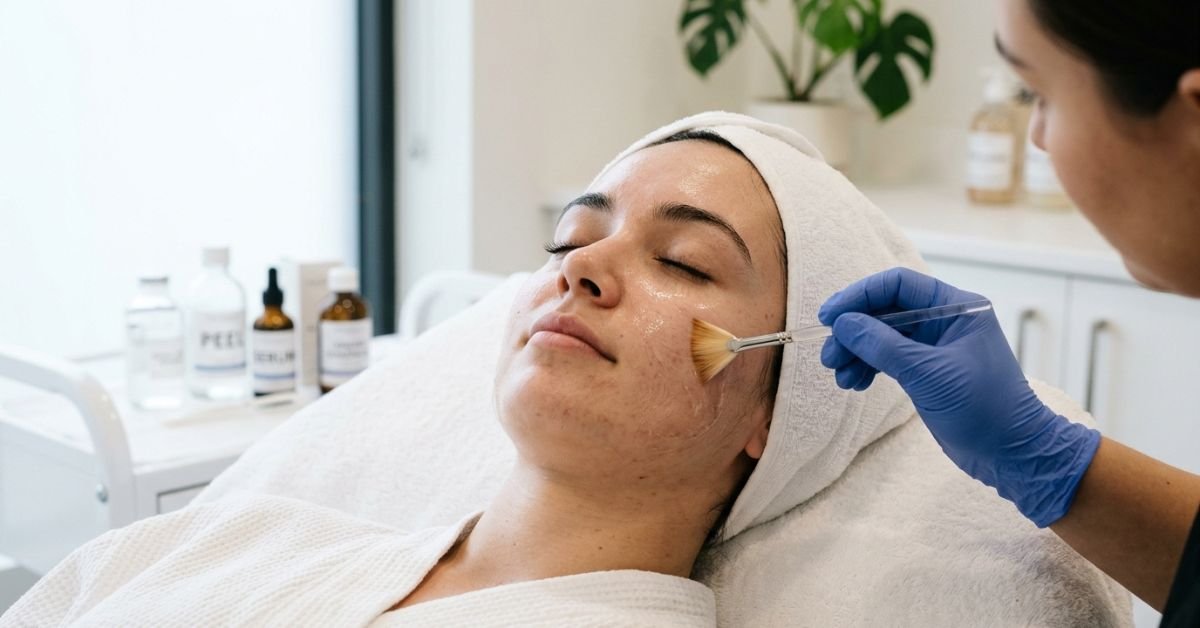
CHEMICAL PEEL COST BY DEPTH:LIGHT,MEDIUM AND DEEP EXPLAINED
Light peels are not sold the way they are used. They are quoted per appointment and prescribed as a course, and the gap between those two things is where budgets quietly collapse. The honest chemical peel cost is closer to an equation than a price tag: depth, multiplied by the number of sessions your skin actually needs, multiplied by the tier of practitioner holding the applicator, plus a short list of expenses that appear on no menu anywhere in the world.
Work through the seven steps below in sequence and you will finish with a figure you can plan around instead of a figure you will later revise upward.
QUICK ANSWER: Chemical peel cost is driven mainly by depth. Light peels sit at the low end but are performed in a series of roughly four to six. Medium peels cost several times more per session and are usually done once to three times. Deep peels are the most expensive by a wide margin and are typically performed only once in a lifetime.
KEY TAKEAWAYS
- Depth is the price. Light, medium and deep peels are three separate procedures with three separate risk profiles, not three sizes of one treatment.
- Cheap peels are rarely cheap in total. A modest per-session figure multiplied across a full course often lands near the cost of a single stronger treatment.
- Expensive peels are not always the expensive option. A once-in-a-lifetime deep peel can undercut a medium peel repeated every couple of years across a decade.
- Recovery is a cost. Days you cannot work, or cannot be seen, belong in the budget alongside the invoice.
- No published average is reliable. The same procedure name covers a fifteen-minute surface treatment and a monitored medical procedure, so any single global figure is meaningless without the depth attached.
BY THE NUMBERS
The bands below are indicative international estimates, expressed in US dollars for comparison. They are intended as a planning framework, not as quoted prices. Every market prices differently, and clinics within the same city routinely differ by half.
Light peel — roughly $100 to $350 per session. Low per visit, almost always multiplied by four to six.
Medium peel — roughly $350 to $1,200 per session. The widest and most confusing band in aesthetics, because the label covers both mild clinic work and physician-supervised resurfacing.
Deep peel — roughly $1,500 to $6,000 as a single procedure. Priced as a medical event, with sedation, monitoring and supervised recovery folded in.
Recovery — from same-day to three weeks. A light peel may leave nothing more than a flush by evening. A deep peel takes over your calendar.
Notice how little those bands overlap. That separation is the whole point. Anyone quoting you one blended average for “a chemical peel” is describing a category, not a treatment — and you cannot budget for a category.
WORK OUT WHICH DEPTH YOUR SKIN ACTUALLY NEEDS
Start with the diagnosis, never the budget. Depth is dictated by the layer of skin your concern lives in, and buying the wrong depth is how people spend a meaningful sum achieving nothing visible.
Superficial peels work on the outermost layer only. They lift dullness, refine texture, soften surface pigmentation and help mild congestion. The effect is gentle and cumulative — one session is a nice glow, a course is a genuine change.
Medium peels reach past the epidermis into the upper dermis. That extra depth is what allows them to address sun-related pigmentation, shallow scarring and lines that a surface peel simply cannot reach. It is also what buys you a week or more of visible shedding.
Deep peels penetrate furthest and are reserved for severe, established damage — etched lines, extensive photoageing, significant scarring. They are performed under medical supervision, often with sedation, and they are a one-time intervention rather than a maintenance treatment.
| DEPTH | REACHES | BEST SUITED TO | RECOVERY | SESSIONS |
|---|---|---|---|---|
| Light / superficial | Outer epidermis | Dullness, mild texture, surface pigment, congestion | Hours to ~3 days | 4–6, spaced weeks apart |
| Medium | Epidermis + upper dermis | Sun spots, shallow scarring, fine to moderate lines | About 1–2 weeks | 1–3 |
| Deep | Deeper dermal layers | Deep wrinkles, severe photoageing, marked scarring | 2–3 weeks, lingering redness | Usually once |
One warning that matters more than any price. Deeper skin tones carry a materially higher risk of pigment disturbance after aggressive resurfacing — the skin can respond to the injury by darkening, sometimes stubbornly. This is not a reason to avoid peels; it is a reason to insist on a practitioner who assesses skin type properly, starts conservatively, and prepares the skin beforehand. The cheapest peel in the world is the one that leaves a mark you then pay to correct.
PRICE THE LIGHT CHEMICAL PEEL COST THEN MULTIPLY IT
This is where the arithmetic bites.
A superficial peel is designed around repetition. Its strength is deliberately low, its downtime is minimal, and its results build across a series rather than arriving after one visit. Practitioners typically plan four to six treatments spaced a few weeks apart, then a maintenance rhythm afterward.
So run the multiplication before you commit to anything:
| COURSE LENGTH | AT $120/SESSION | AT $200/SESSION | AT $300/SESSION |
|---|---|---|---|
| 3 sessions | $360 | $600 | $900 |
| 4 sessions | $480 | $800 | $1,200 |
| 6 sessions | $720 | $1,200 | $1,800 |
A six-session light course at mid-market pricing frequently costs more than one medium peel. Clinics rarely place that comparison in front of you, and it changes decisions more often than any other line in this article.
Then there is maintenance. Surface peel results fade as the skin turns over, so anyone who wants to keep them is signing up to a recurring annual expense rather than making a one-off purchase. Budget it as a subscription, because functionally that is what it is.
PRICE THE MEDIUM CHEMICAL PEEL COST
Medium peels occupy the widest price band in the entire category, and the spread is genuine rather than an error in reporting.
A lower-concentration acid applied to a limited area by an experienced aesthetician and a higher-concentration full-face treatment performed under medical oversight both carry the word “medium”. They are not the same purchase. The difference in price reflects a real difference in formulation strength, chair time, monitoring and complication risk.
What you are paying for at the upper end:
- Stronger formulations that require trained application and controlled neutralisation.
- Medical assessment — the ability to recognise an unusual reaction early and act on it.
- Extended appointment time, since the application is staged rather than swept on.
- Structured aftercare, which is not optional and not brief.
That aftercare window is the hidden expense. Expect somewhere between one and two weeks of visible shedding, redness and sensitivity, during which most people restrict social and professional exposure. For anyone paid by the day, that is not an inconvenience — it is part of the treatment’s true cost, and it should sit in the budget as a real line.
PRICE THE DEEP CHEMICAL PEEL COST AND READ THE SMALL PRINT
Deep peels belong in a different purchasing category altogether. They are closer to a minor medical procedure than to a skincare appointment, and the price reflects that: practitioner expertise, facility standards, sedation or anaesthesia, monitoring during the procedure, and a supervised recovery that runs for weeks.
Two considerations reframe the sticker shock.
Frequency. Light and medium peels repeat; deep peels generally do not. A person who commits to a single deep procedure and a person who returns for medium treatments every eighteen months may spend comparable sums over ten years, arriving at rather different results.
Recovery intensity. The healing period after a deep peel involves genuine wound care — dressings, regular cleansing routines, ointment, strict sun avoidance, and residual redness that can persist for months after the skin has closed. That is weeks of managed recovery, not a long weekend.
It is also worth raising alternatives before you commit. Fractional laser resurfacing now addresses many of the same concerns, and in a number of clinics it has displaced deep chemical peeling entirely. Any practitioner unwilling to discuss that comparison openly has told you something useful about how they price.
ADJUST FOR YOUR MARKET AND YOUR PRACTITIONER
Two readers with identical skin and identical treatment plans can face bills that differ by a factor of five. Geography and practitioner tier explain nearly all of it.
Practitioner tier, from lowest cost to highest:
- Spa or salon aesthetician — surface peels only, mild formulations, no medical oversight.
- Clinic-based aesthetician or nurse practitioner — surface and lighter medium work, quality varies widely by establishment.
- Dermatologist — full depth range, medical assessment, access to prescription-strength preparation and correction.
- Plastic or cosmetic surgeon — medium and deep work with facility, sedation and monitoring included.
That premium is not simply markup on an identical service. It buys assessment, early recognition of complications, and the authority to prescribe when something needs correcting. On a gentle surface peel that margin is genuinely optional. On anything deeper it is the product itself.
Market tier. Rather than quoting individual countries, place your own city into one of three bands:
| MARKET TIER | TYPICAL PROFILE | RELATIVE PRICING |
|---|---|---|
| Tier 1 | Major metropolitan centres in high-income economies; premium districts, high clinic overheads | Baseline to +40% above the bands in this article |
| Tier 2 | Smaller cities in high-income economies, and upper-tier private clinics in fast-growing economies | Roughly in line with the bands above |
| Tier 3 | Regional cities and lower-cost economies with established private aesthetic sectors | Often 40–70% below Tier 1 for equivalent work |
Tier 3 pricing is frequently excellent value, and equally frequently the place where regulation is thinnest. Lower cost is not the risk; unverified credentials are. Apply the same verification standard everywhere, then enjoy the saving.
ADD THE COSTS THAT NEVER APPEAR ON THE PRICE LIST
Build your total from this table rather than from the treatment menu.
| LINE ITEM | TYPICAL ADDITION | USUALLY OMITTED FROM QUOTES? |
|---|---|---|
| Consultation or patch test | Modest; sometimes credited against treatment | Sometimes |
| Skin preparation products, 4–6 weeks beforehand | Moderate and often mandatory | Almost always |
| Post-treatment recovery products | Moderate | Usually |
| Prescription medication for deeper peels | Varies by market | Yes |
| Sedation or anaesthesia for deep peels | Substantial | Sometimes bundled |
| High-factor sun protection, replaced continuously | Ongoing | Always |
| Days of lost income or leave | Your day rate × 3–21 days | Never priced |
| Correction or touch-up if results fall short | Highly variable | Never quoted upfront |
Two structural points worth knowing before you plan. First, peels performed for cosmetic reasons are not covered by health insurance in the vast majority of systems worldwide; the narrow exception is a treatment prescribed for a diagnosed medical skin condition, which requires documentation rather than a preference. Second, preparation products are not an upsell in most cases — priming the skin beforehand meaningfully reduces the risk of pigment problems afterward, and skipping that stage to save money is a false economy.
SANITY-CHECK THE QUOTE BEFORE YOU PAY
Collect three written quotes at the same depth tier within your own market. You are not looking for the lowest; you are looking for the cluster. Once you can see where the local consensus sits, both outliers become informative.
A quote sitting far below the cluster deserves a direct question about who is applying the treatment, what concentration is being used, and what happens if something goes wrong. A quote sitting far above it deserves an equally direct question about what specifically is included that the others omit — facility standards, physician time and comprehensive aftercare are all legitimate answers.
Then read the terms that matter more than the number: the complication policy, the revision policy, and whether follow-up appointments are counted or charged
YOUR PRINTABLE PRE-CONSULTATION CHECKLIST
☐ My skin concern, written in one sentence
☐ My skin tone and any history of pigmentation changes
☐ Depth recommended by the practitioner — light, medium or deep
☐ The specific acid and concentration, named in writing
☐ Number of sessions recommended and the interval between them
☐ Total course price, not the per-session price
☐ Consultation fee, and whether it is credited against treatment
☐ Preparation products required beforehand, and their cost
☐ Aftercare included or sold separately
☐ Sedation, facility and follow-up fees confirmed as in or out
☐ Realistic downtime, converted into working days lost
☐ Practitioner credentials verified independently
☐ Written complication and revision policy
☐ Three comparable local quotes obtained
WHAT TO DO NEXT
- Book an assessment before you compare any prices. Depth determines budget, so the diagnosis has to come first — a consultation fee is the cheapest money you will spend on this.
- Request the course total in writing, with session count and intervals stated alongside the figure.
- Add your Step 6 line items and treat the resulting number as the real cost of the decision.
- Block the recovery into your calendar before paying a deposit. If the downtime does not fit your life, the treatment does not either — and a lighter course is the honest alternative rather than a compromise.
Chemical peels remain one of the most dependable resurfacing options available, and priced properly they represent genuine value against far more invasive alternatives. Priced by the session, they surprise people. Do the multiplication first, and the treatment stops being a gamble and becomes a plan.
FAQ
IS A CHEMICAL PEEL WORTH THE MONEY?
It depends entirely on whether the depth matches the concern. Surface dullness and mild uneven tone respond well to a light course at a manageable cost. Deep lines and established scarring need stronger intervention, and there the fair comparison is against laser resurfacing rather than against a cheaper peel.
HOW LONG DO CHEMICAL PEEL RESULTS LAST?
Surface peel results are the shortest-lived and are maintained through repeat sessions, which is why they belong in an annual budget. Medium peel results hold considerably longer. Deep peel results are the most durable, which is part of the reason the procedure is generally performed only once.
CAN I DO A CHEMICAL PEEL AT HOME INSTEAD?
Home acid products cost far less, but they are formulated at much lower strengths and involve no assessment of your skin type or history. Anything approaching medium depth requires trained application and controlled neutralisation, and attempting that without supervision risks burns and lasting pigment change.