
Travel Insurance For Expensive Jwellery: Complete Guide
A ring worth 7,000 and a policy advertising 4,000 of baggage protection do not necessarily fit together as neatly as the numbers suggest. When comparing travel insurance for expensive jwellery, the real question is how the contract treats your particular item—not simply whether personal belongings appear on the benefits list.
Expensive jewellery introduces several decisions before a trip. You need to establish its value, understand the events covered, check overseas conditions and know what evidence would support a claim.
That preparation matters whether you are travelling for a wedding, a business meeting, a holiday or a family visit.
Quick Answer
Travel insurance can provide jewellery protection when the policy includes the item and the circumstances of its loss. Expensive pieces require particular attention to individual limits, combined valuables allowances and exclusions. Compare existing cover, confirm overseas conditions, document ownership and value, and understand settlement terms before taking jewellery abroad.
Meet The Traveller: One Ring, One Necklace And An Overseas Wedding
Imagine Leila is preparing for an overseas wedding followed by a short holiday. She wants to take an engagement ring with an estimated replacement value of 7,000 and a necklace valued at 1,500.
Leila, her journey and these amounts are fictional. The figures use unspecified currency units so the example can be understood without suggesting a quotation for any particular market.
She already has travel insurance. Her benefits summary mentions baggage protection, so she initially assumes both pieces are included.
However, she cannot answer several basic questions. Would the policy respond if the ring slipped off? Would damage to a gemstone qualify? What if the necklace disappeared and she could not explain when it happened?
Rather than buying additional insurance immediately, Leila writes down what she owns and what she wants protected. She includes the two pieces, their values, the planned wearer and the dates they will be away from home.
Lesson from this phase: Define the protection you need before deciding whether an existing policy provides it.

Before Booking: Leila Checks Her Travel Insurance Jewellery Limits
Leila starts with the baggage section, but she also reads the definitions and exclusions. A benefits summary can introduce the cover without explaining every restriction that affects a claim.
She looks for the overall baggage allowance, the single-item limit and any combined valuables allowance. Each answers a different question.
The overall allowance concerns the baggage claim as a whole. A single-item limit concerns one article. A valuables allowance can restrict a group of possessions, potentially including more than jewellery.
Suppose, purely for illustration, that Leila’s policy has an overall baggage limit of 4,000 but a jewellery limit of 400 per item. That would leave a substantial difference between her ring’s value and the applicable ceiling.
A further issue arises if jewellery, watches and electronics share an allowance. Losing several valuable belongings together could produce a different result from losing one item alone.
Leila also asks whether matching pieces count as one set. She does not assume that two earrings automatically receive two separate limits.
Lesson from this phase: Compare the item’s value with every relevant restriction. A generous overall allowance cannot resolve an inadequate limit for the piece itself.
Comparing Jewellery Insurance For Overseas Travel
Leila considers three possible sources of protection: her travel insurance, personal possessions cover connected to her home insurance, and a separate jewellery policy.
She first asks whether her travel insurer can accommodate the ring’s value. If an upgrade is available, she checks exactly what changes. Increasing the baggage allowance would not help if the ring remains subject to the same restrictive condition.
Next, she reviews her existing possessions cover. She asks whether it follows the item outside her home country, whether the ring needs to be individually listed and which events are included.
Finally, she considers specialist cover. She compares its wording with the protection she already has rather than assuming a specialist label guarantees a better outcome.
The comparison stays focused on practical questions. What happens after accidental damage? Is unexplained disappearance addressed? Does the insurer repair, replace or pay money? What contribution would Leila make herself?
She also keeps the wider purpose of travel insurance in view. Protection for a ring does not answer questions about medical expenses, cancelled travel or other trip-related losses.
Lesson from this phase: Identify the missing protection first. Then compare ways to address that gap without overlooking the rest of the trip.
Worldwide Jewellery Insurance Still Has Eligibility Conditions
The word “worldwide” attracts Leila’s attention, but she treats it as the start of a conversation.
She checks whether she is eligible to buy the policy where she lives. She then checks whether the proposed journey falls within its territorial and duration conditions.
These are separate issues. A policy may protect eligible customers abroad while remaining unavailable to applicants living elsewhere.
Leila includes her transit stops when asking about the trip. She also identifies who will wear the jewellery and whether either piece will be given to someone else during the visit.
She wants the answer reflected in the relevant documents. A broad description on a sales page is less useful than confirmation that addresses her circumstances and agrees with the contract.
Two Weeks Before Departure: Leila Builds Her Jewellery Record
Leila prepares a small digital folder containing the evidence she already has. It includes purchase documents, photographs and any valuation records.
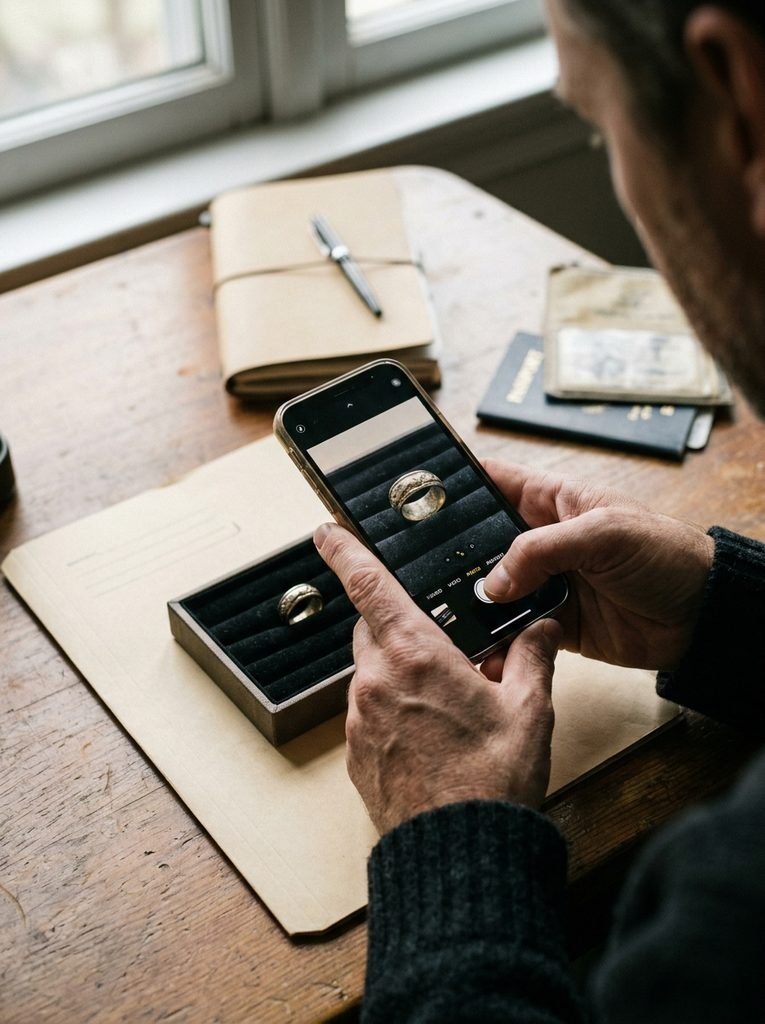
She photographs the ring from several angles, including its setting and identifying marks. For the necklace, she records the clasp, chain and any distinctive features.
The photographs serve a practical purpose. They can help identify the item and show its appearance before departure. They do not necessarily establish an accepted insurance value on their own.
Leila checks what valuation evidence the insurer requires. She asks whether a particular professional qualification, document format or valuation date is necessary.
If the necklace had been inherited, she would explain that an original receipt was unavailable and ask what alternatives could be accepted. She would avoid assuming that missing purchase paperwork makes insurance impossible—or that a family photograph automatically satisfies the requirements.
She stores copies separately from the jewellery and makes sure she can retrieve them if her phone is lost.
She also reviews the stated values. An old purchase price and the cost of obtaining an equivalent replacement today may differ.
Lesson from this phase: Build the record while the jewellery is available to inspect. Confirm what evidence is acceptable before depending on it.
Choosing Cover: Leila Compares The Cost With The Remaining Risk
Leila receives quotations with different prices and conditions. Instead of comparing premiums alone, she considers what each arrangement would leave her responsible for after a covered loss.
She checks the deductible or excess, the insured amount, any applicable limits and the basis of settlement.
For example, a cheaper policy might require a larger personal contribution. Another could offer a lower deductible but include a restriction that matters more to her journey.
She asks how a claim would be handled if the ring could be repaired. Would the insurer arrange the work? Could she use her usual jeweller? Would approval be needed before repair began?
Replacement raises different questions. Leila wants to understand how an equivalent item would be selected and what happens if the original design cannot be reproduced.
For inherited jewellery, the distinction between financial and sentimental value deserves particular thought. A payment or replacement may address an insured financial loss without restoring the original object’s personal meaning.
Leila records the answers and checks them against the final schedule and wording before accepting the policy.
Lesson from this phase: Assess the financial result and the practical process together. The premium alone does not describe the protection.
Packing Day: Leila Turns Policy Conditions Into Practical Habits
After considering the trip, Leila decides to take only the ring. The necklace is not essential for the wedding, and leaving it behind reduces the number of valuable possessions she must manage.
She plans how the ring will travel, where it will be stored and what she will do when she needs to remove it.
Keeping jewellery under her control during the journey can reduce opportunities for loss. However, her handling choices do not replace the policy conditions or guarantee that every incident would qualify.
She checks the rules that apply to unattended belongings, accommodation storage and vehicles. If the wording refers to a safe, she asks what storage arrangement is required.
At the airport, she avoids placing the ring loose in a tray. If she needs to remove it, she uses a designated container and checks that container before leaving the area.
She also prepares for an unexpected change, such as being asked to check a cabin bag. Her plan is to remove the jewellery before surrendering the bag, subject to the instructions she receives.
Lesson from this phase: Decide how you will handle the jewellery before a busy travel moment forces a rushed choice.
Swimming And Activities Need Their Own Decision
Leila’s itinerary includes a beach visit and a boat outing. She decides in advance whether the ring will accompany her.
Wearing an item, carrying it in a bag and leaving it in accommodation create different practical risks. The insurance implications depend on the wording and circumstances.
If she wants to wear the ring while swimming, she asks about that exact situation. A general answer about the trip being insured would not resolve the question.
She also checks whether any activity-related exclusion affects personal possessions separately from other benefits.
Her aim is to avoid repeatedly removing the ring in unfamiliar places. A consistent storage routine is easier to follow than an improvised decision at every stop.
During The Trip: The Ring Goes Missing
Now imagine that Leila returns from an afternoon outing and discovers the ring is missing. She remembers wearing it earlier but cannot identify the moment it disappeared.
She retraces her movements and checks her belongings carefully. She contacts the places she visited and records when she last remembers seeing the ring.
She distinguishes what she knows from what she suspects. There is no witnessed theft, and she does not know whether the ring slipped off, was misplaced or was taken.
That uncertainty should remain part of her account. Describing an unexplained disappearance as a confirmed theft would create an inaccurate record.
Leila checks the policy’s notification instructions and contacts the insurer promptly. If a police, venue or transport report is relevant, she asks what is required and how to obtain it.
If a requested document is unavailable, she explains the difficulty and asks what other evidence might be considered.
She keeps a simple timeline while the details are fresh.
Lesson from this phase: Record the event honestly and promptly. A clear account is more useful than an assumption about what must have happened.
Starting Jewellery Insurance Claims From Abroad
Leila asks the insurer for a claim reference and a list of required documents. She also checks whether any immediate action could affect the assessment.
Her submission includes the item details, available ownership and valuation evidence, her account of the loss and relevant correspondence.
She explains any gaps rather than filling them with guesses. If she cannot remember an exact time, she provides the narrowest accurate time range she can.
She also tells the insurer about any other policy or recovery process that may relate to the same loss. She asks how those arrangements interact.
For a damaged piece, the approach would differ. Photographs, inspection and a repair estimate might become relevant. Before authorising non-urgent repairs, Leila would check what approval or evidence the insurer needs.
Throughout the process, she keeps copies of submitted documents and notes the date of each communication.
Providing complete information helps the insurer assess the claim. It does not turn an excluded event into a covered one.
Lesson from this phase: Make the claim easy to understand, support it with available evidence and follow the actual process supplied by the insurer.
Leila Checks The Settlement Before Accepting It
If the claim is accepted, Leila reviews the proposed outcome against the policy.
She asks how the insurer calculated the amount, which limits applied and how any deductible was treated. If replacement is offered, she checks the proposed item’s relevant characteristics.
She does not assume that a valuation figure must produce an identical cash payment. The settlement provisions need to be considered alongside the value recorded.
If the claim is declined, she requests a written explanation identifying the relevant terms and the reasons they apply.
She then checks whether the insurer has understood her account correctly and considered the documents supplied. If she disagrees, she follows the complaint procedure and checks the applicable local options for further review.
After The Trip: What The Scenario Reveals
Leila’s preparation began with a question about whether her jewellery was insured. It became useful once she separated that question into value, events, location, handling and settlement.
That approach made the decisions more manageable. She could identify a potential gap, compare suitable arrangements and prepare records without relying on a vague impression of being covered.
Travellers should review their arrangements when a valuable piece exceeds a policy limit, its value has changed or the next journey introduces unfamiliar conditions.
Those with confirmed protection may simply need to check that their documents and trip details remain current. Additional insurance should have a clear purpose.
If the protection is uncertain and departure is close, taking a less valuable alternative or leaving the piece securely at home can be a sensible choice.
The decision is personal. The aim is to make it with a clear understanding of the financial risk and the insurance terms.
Key Takeaways
- Compare the jewellery’s value with all applicable limits.
- Check existing insurance before purchasing additional cover.
- Confirm the territory, duration, wearer and covered events.
- Prepare acceptable ownership and valuation evidence.
- Plan storage and handling around the policy conditions.
- Keep an accurate record if an incident occurs.
| Decision Point | What To Check | Practical Purpose |
|---|---|---|
| Value | Accepted valuation and insured amount | Identify a possible shortfall |
| Limits | Individual, valuables and overall limits | Understand applicable ceilings |
| Events | Loss, theft, damage and disappearance | Know which circumstances are addressed |
| Travel conditions | Destination, duration and wearer | Check the proposed journey |
| Evidence | Photographs, receipts and valuations | Support identification and assessment |
| Settlement | Repair, replacement, payment and deductible | Understand the possible outcome |
Frequently Asked Questions
Can I Insure Jewellery Bought During My Holiday?
Ask whether new purchases receive any automatic protection and what notification requirements apply. Keep the purchase records and confirm the effective date of any additional cover. Existing insurance should not be assumed to protect every new item at its full value.
Can Borrowed Wedding Jewellery Be Covered?
Check whether the policy accepts borrowed items. Explain who owns the jewellery, who will wear it, its value and the travel dates. The owner’s insurance and the wearer’s insurance may need to be considered separately.
Does Engagement Ring Travel Insurance Cover A Proposal Abroad?
Check protection before and after the proposal. The person carrying the ring may initially differ from its eventual owner or wearer. Ask whether giving the ring to the recipient changes any relevant policy details or notification requirements.
Will Insurance Replace Both Earrings If Only One Is Lost?
Read the pairs-and-sets provisions and ask how settlement would work. The insurer may need to consider the remaining piece, the possibility of a matching replacement and any conditions attached to settling the pair.
Can I Buy Jewellery Cover After My Trip Has Started?
Ask the insurer whether it accepts applications during a journey and when protection would begin. Do not assume immediate acceptance. Any incident that has already occurred must be disclosed and cannot be treated as a future risk.