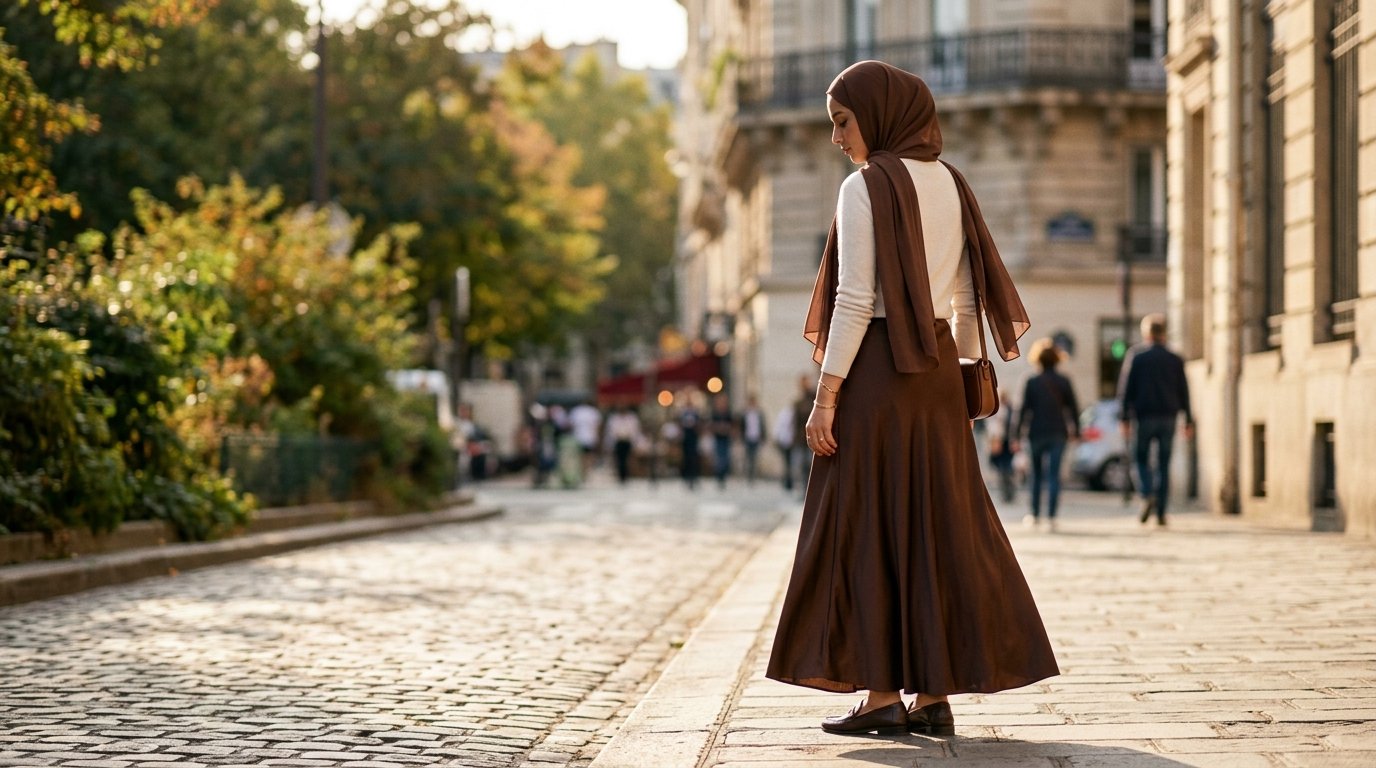
Modest Transitional Outfits: The August Problem Nobody Writes About
Every summer-to-fall styling guide gives you the same instruction: add a layer. Throw a cardigan over the sundress. Knot a jacket at the waist. It is perfectly good advice for someone who spends July in a tank top — and completely useless if you don’t.
What are modest transitional outfits, and how do they differ from ordinary layering?
Modest transitional outfits bridge late summer and early autumn without adding bulk. Because a modest wardrobe is already at full coverage, the transition is made by changing fabric weight, drape and colour depth rather than stacking layers — swapping linen for satin, and pale neutrals for burgundy or chocolate brown.
That distinction is the whole article. If you already dress modestly, you spent July at maximum coverage in maximum heat. You do not have a spare layer to add. What you have instead is a different set of levers — and they’re arguably better ones.
Why standard transitional advice fails a modest wardrobe
Mainstream transitional dressing assumes a starting point of minimal coverage and a destination of maximum coverage. The whole method is additive: you begin with less fabric and finish with more, and the in-between weeks are managed by adding and removing pieces as the temperature swings.
A modest wardrobe starts where that journey ends. In August you are already wearing long sleeves, a full-length hem and, for many readers, a scarf. Add a cardigan to that and you have not created a transitional outfit — you have created a heat problem.
This is why so much seasonal styling content feels vaguely unusable if you dress modestly. It isn’t badly written; it is simply solving a problem you don’t have, and ignoring the one you do. Modest transitional outfits need their own method, not a modified version of someone else’s.
There is a second, subtler failure. Layering advice treats layers as visual interest: the contrast of a jacket over a dress is what makes the outfit look considered. When every layer is already present, that visual interest has to come from somewhere else — from texture, from proportion, from colour, from the shoe. Modest dressing does not lack tools. It uses different ones.
So here is the reframe that makes the next six weeks easy. You are not adding. You are swapping. Three swaps, in a specific order.
The three swaps that actually make the transition
Swap one: change the fabric weight, not the layer count
This is the highest-leverage change and almost nobody talks about it, because in a non-modest wardrobe fabric is a minor variable and coverage is the major one. Reverse that.
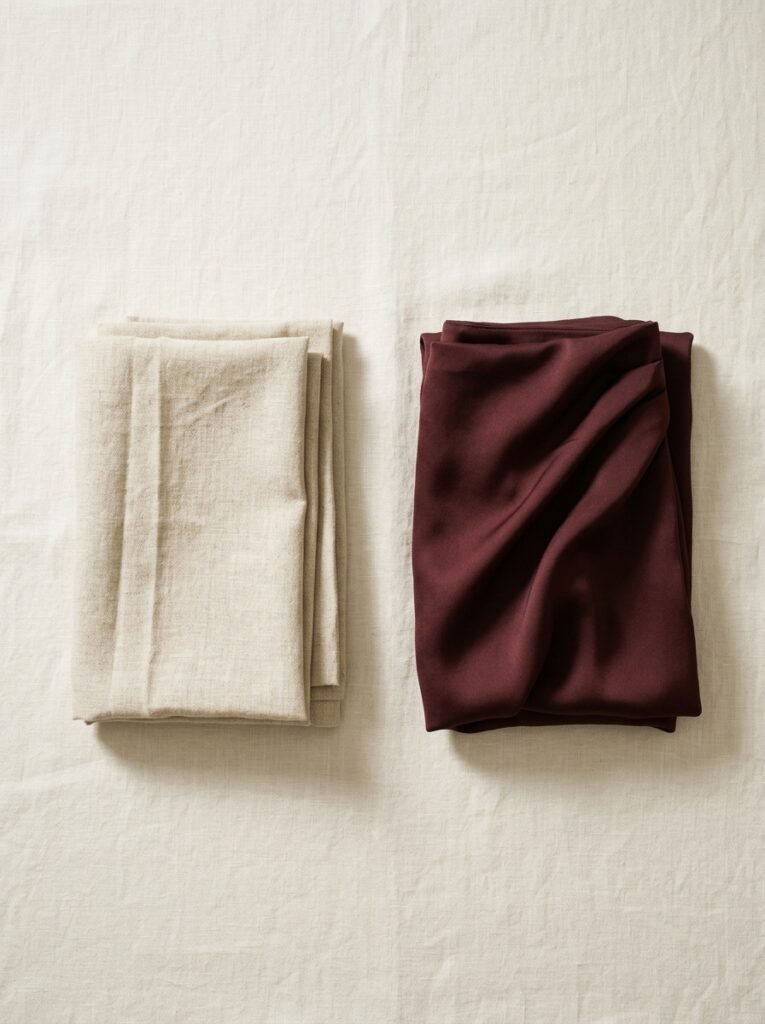
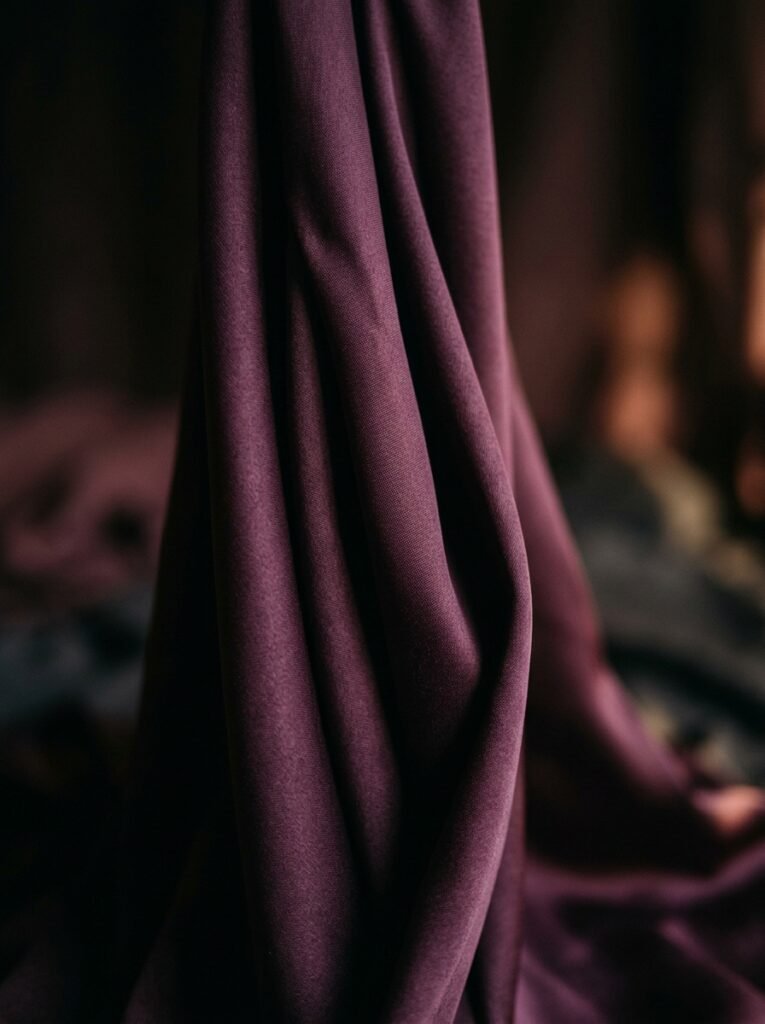
The fabrics that carry a modest summer — cotton lawn, linen, crinkle chiffon, poplin — read as summer not because they’re thin but because of how they behave. They’re matte, they’re crisp, they hold air. The fabrics that read as autumn at exactly the same weight are the ones with drape and a bit of surface: satin-backed crepe, matte satin, viscose twill, Tencel, fine modal jersey, ponte.
Move from crisp to fluid and an outfit changes season without gaining a single gram of insulation. A wide-leg trouser in linen is a July trouser. The identical trouser in a matte satin is a September trouser. Same coverage, same breathability, completely different read.
Practical version: if you are shopping one thing this month, make it a matte satin or viscose-twill maxi skirt or wide trouser in a deep shade. It works at 30°C and it works at 18°C, and it does more seasonal work than any jacket you could buy.
Worth knowing, because the labels confuse people: satin is a weave, not a fibre. It can be woven from silk, polyester, nylon or cotton, and it comes in weights from featherlight to upholstery-heavy. Two versions are worth asking for by name. Matte satin — sometimes sold as peau de soie — has a low-lustre finish on both faces, so it reads expensive in daylight rather than shiny. Crepe-back satin, also labelled satin-backed crepe, is reversible: glossy on one side, textured matte crepe on the other, so a single skirt can be worn two ways. Both behave far better in heat than the slippery liquid-look satin most people picture.
Swap two: change the colour depth before you change the weight
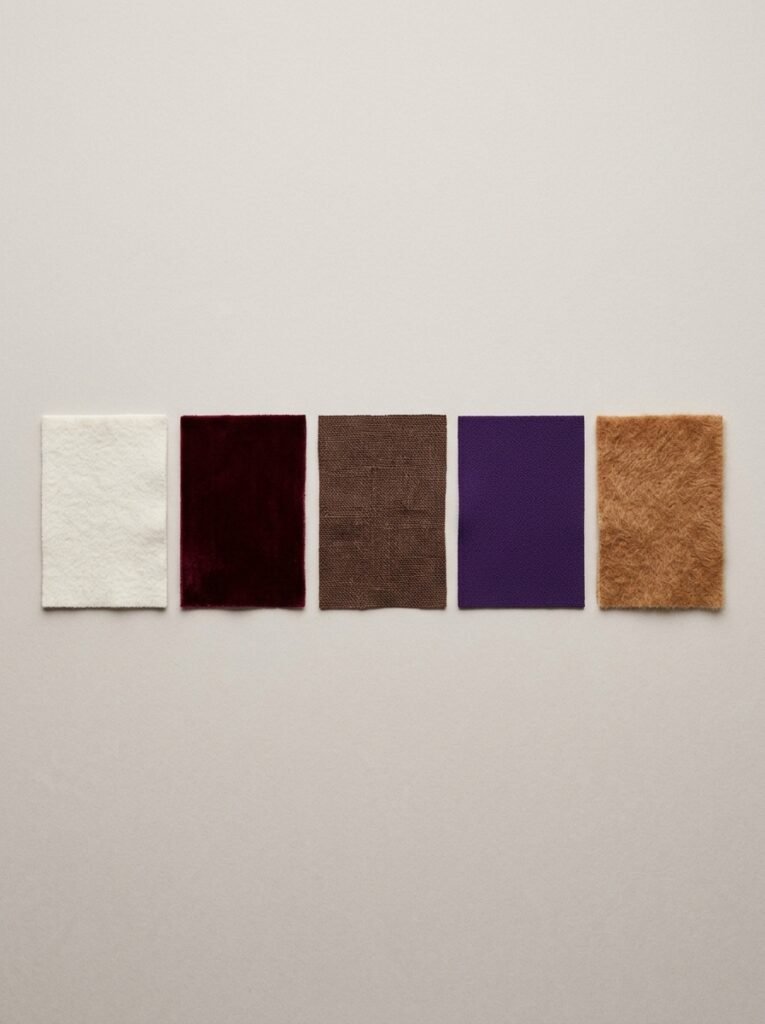
Colour does more seasonal signalling than temperature does. A cream and pale-blue outfit in mid-September looks like a leftover. The same silhouette in burgundy or chocolate brown looks entirely intentional — and weighs the same.
This is the cheapest transition available, because it costs nothing if the pieces are already in your wardrobe. Start with whichever piece is largest — the abaya, the maxi dress, the trouser — and take that one item into a deep shade. Everything around it can stay light.
The autumn 2026 palette is unusually generous to modest wardrobes because it is dominated by rich, saturated depth rather than muddy neutrals. Purple is having a genuine moment: Who What Wear’s fashion month roundup logged it across Celine, Mugler, Chloé, Ferragamo, Loewe, Balenciaga and Tory Burch, and it reappeared in their July shopping edit as a trend worth buying rather than a runway curiosity. Burgundy and chocolate brown continue their run.
And in an unexpectedly convenient twist, the season’s most-discussed neutral is also its most transitional. Pantone named Cloud Dancer, a soft off-white, its Colour of the Year for 2026 back in December 2025 — and off-white is the one pale shade that does not read as leftover summer. Paired with chocolate or aubergine it reads as deliberate autumn styling.
Swap three: let the shoe carry the season
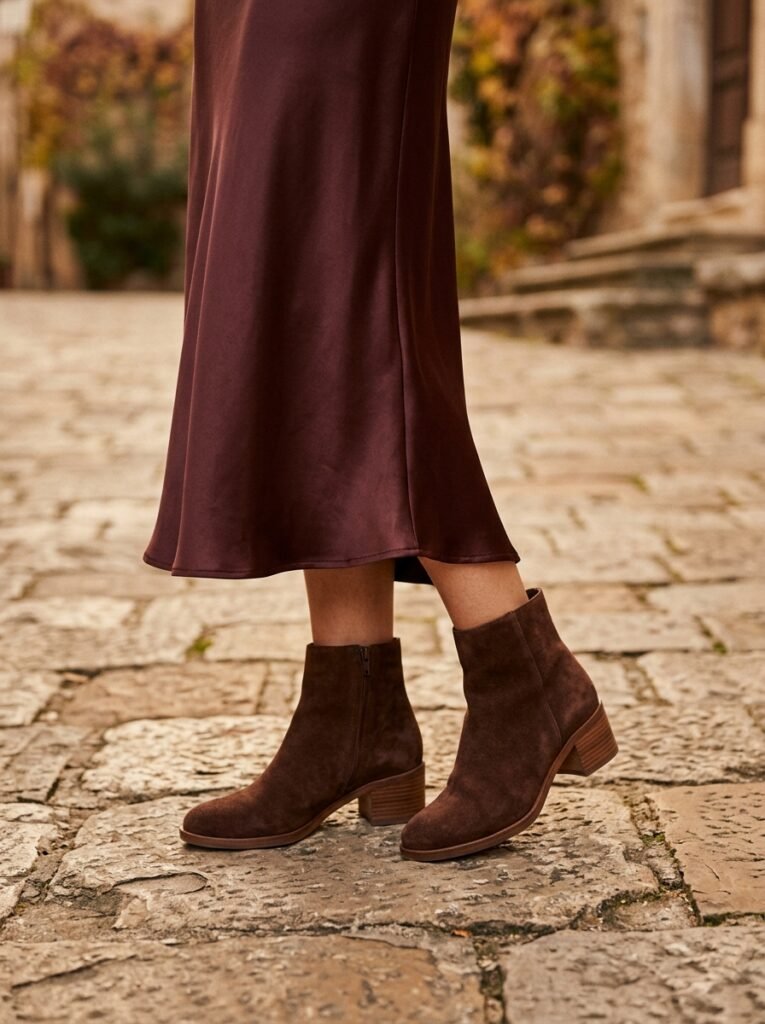
The fastest transitional signal on any outfit is at the bottom of it, and it requires no heat commitment at all — feet are the one place you can dress for October while the rest of you dresses for August.
Suede boots are the anchor here. Global News’s fashion desk named them one of five defining fall 2026 buys in late July, with chocolate brown leading and caramel and taupe as the classic alternates. A closed suede boot under a satin maxi is a complete transitional outfit; nothing else has to change.
If boots are too much heat, two-tone shoes are the other route. Cap-toe styling — a contrast toe on a flat, a loafer or a low boot — was picked out by Who What Wear as a trend to buy for fall 2026, credited largely to Chanel. It reads as considered, seasonal footwear without any of the warmth.
When to actually make the switch
There is no calendar date for this. The useful trigger is the gap between your morning and afternoon temperature, not the number on the month.
Gap under 5°C, afternoons still above 28°C. Stay in summer fabrics and make the change through colour and footwear only. Deepen one piece, put on a closed shoe, leave everything else alone. This is where most of late July and early August sits.
Gap of 5–10°C, afternoons in the low-to-mid twenties. This is the true transitional window and where the fabric swap earns its keep. Fluid drape all day, one optional cropped layer for the morning. Most modest transitional outfits are built for exactly this band.
Gap over 10°C, mornings under 15°C. You are in autumn dressing proper. Add the funnel-neck layer, move to full-depth colour, bring in knitwear with actual weight.
The reason this matters is that the transitional period is genuinely long — six to eight weeks in most of the US and UK — and treating it as a single condition is why people either overheat in September or look out of season in August.
One more practical note specific to covered dressing: pay attention to what sits closest to your skin. A fluid outer layer over a clinging synthetic base defeats the entire point. Fine modal, Tencel and cotton jersey next to the skin, fluid drape on the outside — that combination is what makes full coverage comfortable in heat, and it is the part of modest transitional outfits that mainstream guides have no reason to ever think about.
Six modest transitional outfit formulas for August into September
These are formulas rather than shopping lists — the point is the structure, and you substitute what you own. Each one is a complete outfit as written, and each one holds up on a hot afternoon.
1. The satin column. Matte satin maxi skirt in chocolate or aubergine + fitted fine-knit long-sleeve top in off-white + suede ankle boot + coordinating scarf. One deep piece, one light piece, seasonal footwear. This is the outfit to default to on a day you cannot think.
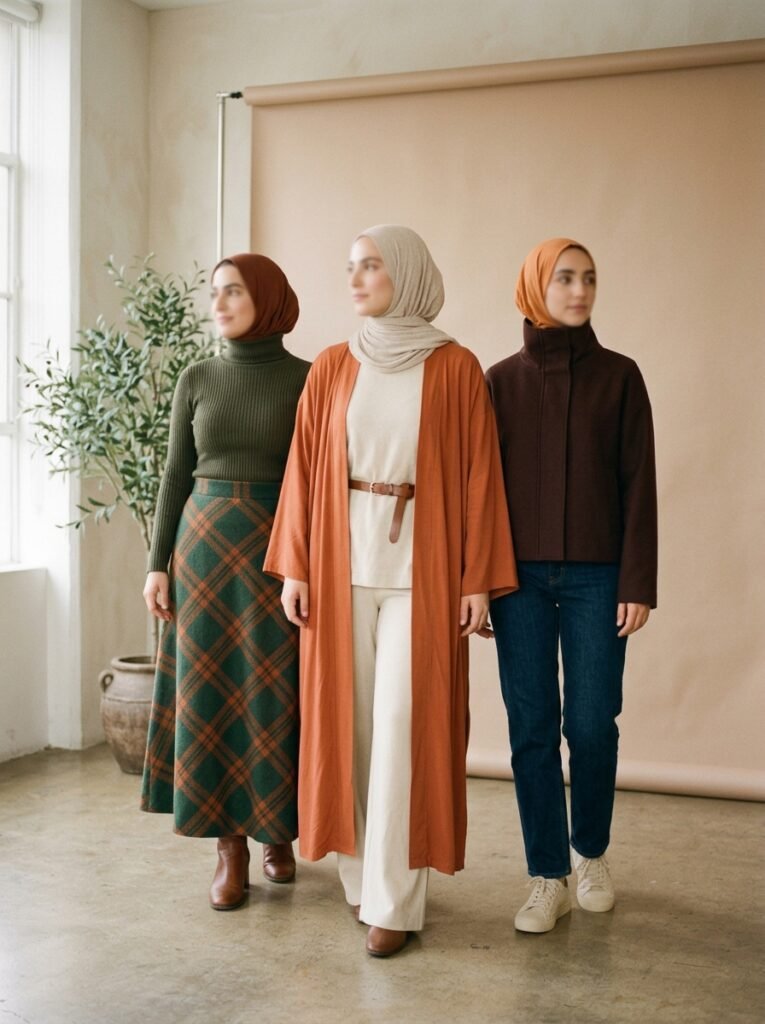
2. The tonal abaya, restyled. Open abaya in a fluid viscose + wide trouser and top beneath in a single tone one shade lighter + belt at the natural waist over the abaya + loafer. Belting the open layer is what converts it from summer-loose to autumn-structured. No fabric added.
3. The funnel neck. Lightweight funnel-neck jacket or high-collared overshirt in a deep shade + straight-leg dark-wash denim + long-line top beneath. The high collar builds coverage into the garment, which means you can wear it instead of a scarf-plus-layer combination rather than on top of one.
4. The check statement. Bold-check maxi skirt or wide trouser + plain deep-toned knit + plain shoe. Checks are doing heavy lifting this season — Who What Wear listed bold checks among the eight trends worth buying for fall 2026 — and one patterned piece with everything else quiet is the modest-friendly way to wear a loud print.
5. The monochrome stripe. Striped long-sleeve top in two closely-related deep tones + matching-tone maxi skirt + two-tone flat. Stripes were on the Global News fall list, and a tonal stripe adds the visual texture that layering usually provides, without the layer.
6. The evening-adjacent. Satin or brocade-detail maxi in a jewel tone + ornate earring or brooch + closed shoe. Opulent eveningwear is one of the season’s flagged directions, built on brocade, embroidery, fringe, velvet and gloves. Modest wardrobes are structurally suited to it — the drama sits in surface and detail rather than in exposure.
The fall 2026 trends that were practically designed for modest dressing
Something genuinely interesting happened on the autumn/winter 2026 runways: several of the dominant directions require more fabric, not less. Read the season through that lens and a lot of it is directly wearable.
Funnel necks and exaggerated high collars
The tall, sculptural collar has been building since the SS26 outerwear season, where Alaïa’s dramatic funnel-neck coat became the reference point, and it landed in the fall 2026 buying guides as a practical transitional layer. For modest dressers this is close to a perfect trend: coverage is engineered into the garment, so the neckline is handled by the design rather than by an extra piece. It also frames the face, which is why it photographs so well.
“Window dressing” — the sheer trend, worn covered
Sheer has been the awkward trend of recent seasons for anyone dressing modestly. Fall 2026 offers a workaround. Who What Wear grouped translucent layering — clear PVC, structured mesh, organza worn over solid fabric — under the heading “Window Dressing”, noting it at Prada, Tom Ford, The Row and Victoria Beckham, and framing it as the season’s restrained take on sheer dressing.
On the runway the translucent layer is a window onto the look beneath. The modest adaptation is simple and it barely changes the effect: make that base fully opaque and lined, and the transparency becomes texture rather than exposure. A mesh or organza overlayer on top of a lined dress adds dimension while coverage underneath is unchanged. Structured mesh in particular breathes better than knit, which makes it a real August option rather than a theoretical one.
Shrunken jackets — the one layer that genuinely works
If you are going to add a single layer this season, this is it. The fitted, cropped jacket was named as a fall 2026 buy, credited to Gucci, and it is the rare outer piece that suits a wardrobe that is already covered: it stops at or above the waist, so it doesn’t compound length, and its structure creates proportion and shape rather than volume.
Worn over a long-line dress or a high-waisted maxi skirt, a shrunken jacket introduces a defined waist without a belt and reads instantly as autumn tailoring. On a hot day it can be carried and still work as part of the look.
Satin, purple and bold checks
The three commercial trends most worth your money this season, and all three are silhouette-neutral, which is the crucial point — they work at any level of coverage. Satin turns up across tops, skirts, trousers and bags. Purple ran through the entire autumn/winter fashion month. Bold checks moved from background pattern to statement piece. None of them asks you to change how much you cover; they only change what the fabric does.
What to skip — and it is worth skipping
A short list, because knowing what not to buy in a transitional month saves more money than any deal.
In Who What Wear’s fall 2026 shopping edit, one of the outlet’s shopping editors put linen, wedges, yellow, gingham, hyper-minimalist styling, moto jackets, dainty jewellery and bold psychedelic prints in the skip column. That is a personal aesthetic call rather than a verdict on quality — but two of the eight matter especially here.
Linen is the trap. It feels like the sensible transitional fabric because it’s breathable and it comes in autumn colours — but its crispness reads permanently as summer no matter what shade it’s dyed. It is exactly the fabric that makes a September outfit look like a July one, and it is the single most common mistake in modest transitional outfits. Wear out the linen you own through August, then put it away.
Dainty jewellery is being replaced by ornate, baroque-influenced pieces — larger necklaces, statement earrings, brooches. For modest dressers this is straightforwardly good news, because a single strong accessory does the work that an exposed neckline or arm would otherwise do.
Build a transitional capsule: nine pieces
If you want a shopping structure rather than a shopping list, this is the whole season in nine slots.
- Matte satin or viscose-twill maxi skirt — deep shade
- Wide-leg trouser — same fabric family, different tone
- Fine-knit long-sleeve top in off-white
- Fine-knit long-sleeve top in a deep tone
- Lightweight funnel-neck jacket or high-collared overshirt
- Shrunken or cropped structured jacket
- Straight-leg dark-wash denim
- Suede ankle or knee boot in chocolate
- One statement accessory — an ornate earring, a brooch, or a two-tone flat
Nine pieces produce well over twenty modest transitional outfits, and only two of the nine are true outerwear. That ratio is the point of the whole method: the season is carried by fabric and colour, not by layers.
One date to have in your diary
The spring 2027 collections are shown in September, and they set the conversation for the following year. Fashionista published the provisional calendars in July: New York opens on 10 September 2026, Milan hosts the debut of Moschino’s new creative directors on 25 September, and Paris runs 28 September to 6 October, with debuts expected at Carven and Courrèges. If you like to see trends before they reach the shops, that fortnight is where they surface.
Key Takeaways
- Modest transitional outfits are built by swapping, not by layering — a wardrobe already at full coverage has no spare layer to add.
- Change fabric behaviour first: crisp linen and poplin read as summer; fluid matte satin, viscose twill, Tencel and modal read as autumn at the same weight and breathability.
- Change colour depth second. Take your largest piece into burgundy, chocolate brown or purple and leave everything else light.
- Let footwear carry the season — suede boots or two-tone cap-toe flats signal autumn with no heat cost.
- Fall 2026’s runway direction genuinely favours coverage: funnel necks, “window dressing” translucent layering over opaque bases, shrunken jackets, satin and bold checks.
- Skip linen. It is the single most common transitional mistake, and no amount of autumn dye fixes its crispness.
- Nine pieces will cover the whole August-to-October window.
FAQ
Q: What are modest transitional outfits? A: They are outfits that bridge late summer and early autumn without adding coverage or bulk. Because a modest wardrobe is already fully covered, the seasonal shift is achieved by changing fabric weight and drape, deepening the colour palette, and switching to autumn footwear rather than adding layers.
Q: How do you layer modestly without overheating in August? A: Mostly by not layering. Replace crisp summer fabrics such as linen and poplin with fluid ones such as matte satin, viscose twill, Tencel or fine modal, which read as autumn at the same weight. If you do add one piece, make it a cropped or shrunken jacket that stops at the waist.
Q: What colours work best for modest fall 2026 outfits? A: Purple ran across the entire autumn/winter 2026 fashion month, and burgundy and chocolate brown remain dominant. Pantone’s 2026 Colour of the Year, Cloud Dancer, is a soft off-white that pairs with all of them and is the one pale shade that does not read as leftover summer.