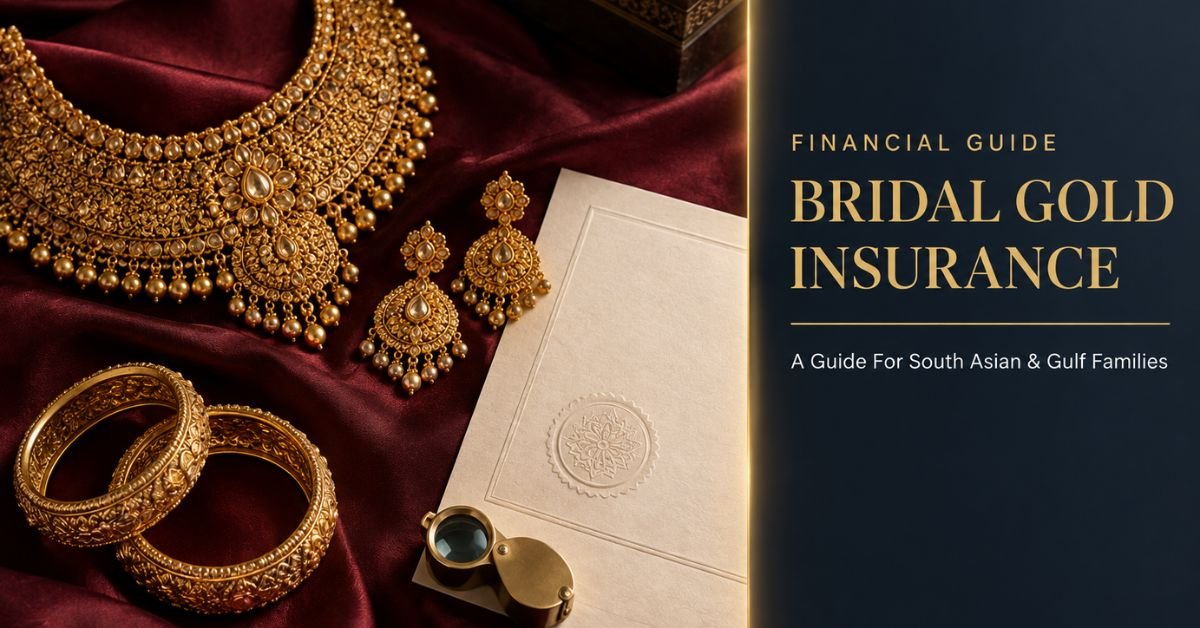
Bridal Gold Insurance: A Guide For South Asian and Gulf Families
Insurance systems around the world were designed around the idea that a family owns one meaningful piece of jewellery an engagement ring, perhaps a watch. South Asian and Gulf-Arab weddings break that assumption completely. A bride may wear a necklace, a choker, two bangles, a maang tikka, earrings, rings and armlets, all in one evening, all in one household’s name.
Bridal gold insurance exists in the gap between that reality and the policy wording. It matters just as much in Toronto or Manchester as it does in Karachi or Riyadh, because the gold travels with the family even when the insurance market does not. This guide follows a bridal set through its own life counter, certificate, ceremony, journey, cupboard, crisis, renewal because that is the sequence in which the danger actually shows up.
What Is Bridal Gold Insurance
Bridal gold insurance is protection that pays to replace wedding jewellery if it is stolen, lost or damaged. It generally arrives in one of three shapes: a listed-items extension on a home contents policy, a dedicated jewellery policy, or short-term cover bought for the wedding dates alone. In nearly every version, each piece must be described and valued before cover applies.
The Lifecycle Of A Bridal Set — At A Glance
- Stage 1 — Purchase: the paper trail is created, or lost forever
- Stage 2 — Valuation: an independent figure replaces family estimation
- Stage 3 — Wedding week: the gold is worn, handled and moved constantly
- Stage 4 — Travel: flights, borders and declaration counters
- Stage 5 — Storage: vaults, safes and a relative’s almirah
- Stage 6 — Loss: theft, disappearance, damage or dispute
- Stage 7 — Renewal: the market moves and the policy quietly stops matching
The Buying Months — Paper Beats Memory
Whether a claim eventually succeeds is usually decided at the jeweller’s counter, long before any policy is bought. Underwriters do not pay for what a family remembers; they pay for what a family can show.
Insist on an invoice that breaks the purchase down: gross weight, net gold weight, purity, stone weight if any, and making charges listed separately from metal cost. One line reading “bridal set” with a lump sum is a document that will not survive scrutiny.
Photograph every piece the week it comes home. Lay it flat on a plain cloth, include something for scale, and take one close frame of any engraving, hallmark or clasp detail. Then move those photographs off the phone and off the household computer, because a burglary that takes the gold often takes the devices too.
Inherited pieces come with no receipt at all, and that is precisely when documentation becomes urgent rather than optional. Older jewellery is also the most commonly under-valued, since families tend to remember the price paid rather than what replacement would cost today.
The Valuation Window — Before Anything Is Worn
A bridal jewellery valuation certificate is the document that turns a family heirloom into an insurable asset. Without it, an insurer is being asked to accept a number on trust, and few will.
Where the market allows it, use a qualified valuer who did not sell you the jewellery. Independence costs a little more and is worth a great deal if a claim is ever questioned.
Ask for the certificate to describe each item on its own line, with weight, purity, gemstone detail and a replacement figure. A single combined total creates a specific failure later: when one bangle vanishes from a set of ten, nobody can agree what that bangle alone was worth.
This is also the point to choose between agreed value and replacement value cover. Agreed value locks a payout figure in advance and suits custom, antique or irreplaceable work. Replacement value pays what an equivalent piece costs on the day of loss, which usually serves plain gold sets better when metal prices are climbing.
The Wedding Week — Days Of Maximum Exposure
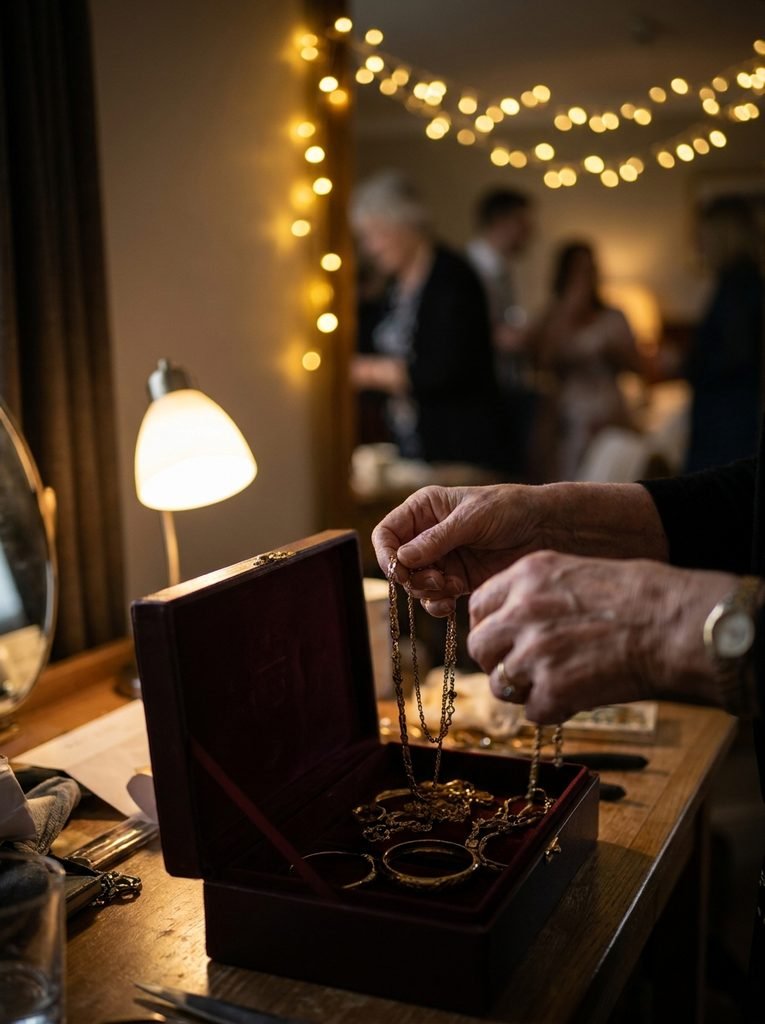
No other period in the jewellery’s life carries as much risk, and almost nobody insures it specifically. The gold is out of storage, worn among hundreds of guests, passed between dressers, stylists and photographers, and shuttled between venues by people running on two hours of sleep.
Home policies are written around a building. Once jewellery leaves the insured address, protection either disappears or collapses into a small away-from-home allowance that bears no relationship to what a bridal set is worth.
The remedy is a personal-possessions extension with wide enough territorial scope, or a short-duration wedding policy covering the specific dates. Before buying either, ask two blunt questions: does it cover an item that simply goes missing with no sign of a break-in, and does it cover jewellery left inside a hotel room?
Many policies impose conditions here — valuables must be worn, carried, or locked in a room safe. A necklace resting on a dressing table while the bride is on stage can fall outside cover even under an otherwise sound policy.
The Journey — Airports, Borders And Declarations
For families spread across continents, this stage is unavoidable. Gold is bought in one country and worn in another, then flown back again, often several times across a decade of family weddings.
Never place bridal gold in checked baggage. Insurers exclude valuables in hold luggage almost universally, and an airline’s own liability for lost bags is capped far below the value of a single ornament.
Declare gold at customs wherever local thresholds require it. Confiscation of an undeclared item is not an insured event, and a claim built on an undeclared movement will not be looked upon kindly.
For families living abroad, gold insurance for expats hinges on one clause most people never read: the territorial limit. A policy issued in one country may cover the world, one continent, or nothing beyond the front door. If the wedding is overseas, ask for the destination country to be confirmed in writing before departure.
The Quiet Years — Vaults, Safes And False Comfort
Once the celebration ends, most bridal gold disappears into storage, and most families assume the danger ends with it. The danger does not end; it simply becomes patient.
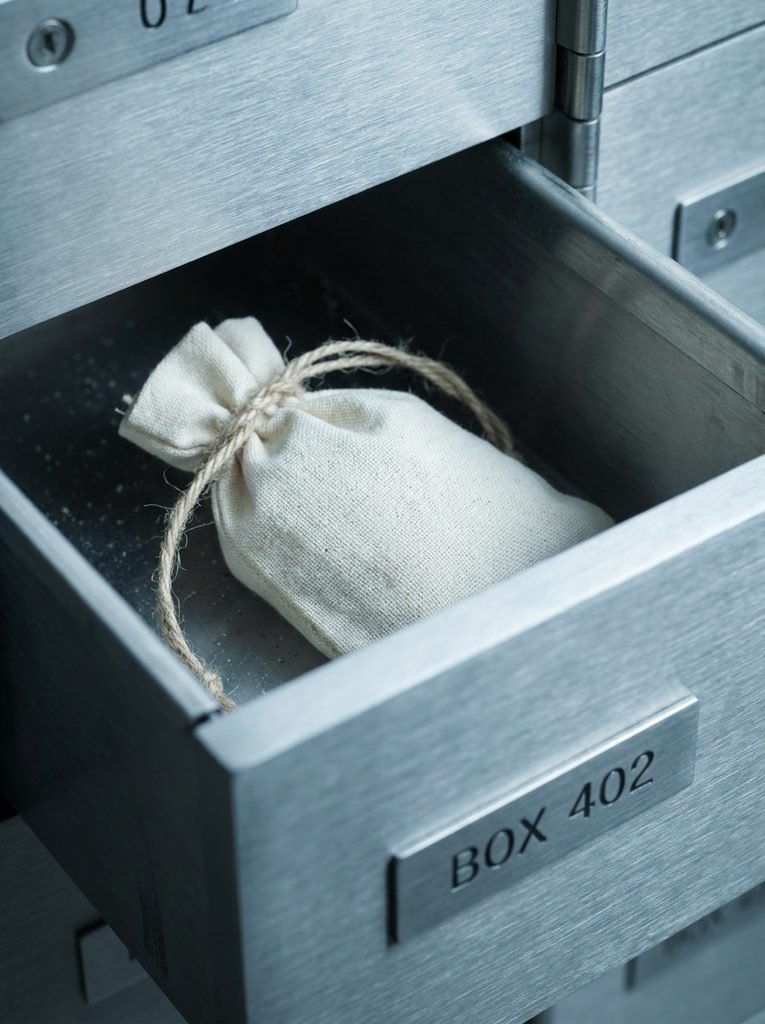
Bank vaults and safe deposit boxes are the traditional choice in many countries, and they genuinely reduce risk. But the agreement customers sign often limits the bank’s responsibility sharply, and in many arrangements the institution does not insure the contents at all — the customer is expected to.
A home safe protects only to the standard it is built and fitted to. Insurers frequently require a specified safe rating above a certain insured value, and a safe that is not bolted into structure is simply a heavy box a thief can carry away.
The most common uninsured arrangement in these households has nothing to do with hardware. Gold is routinely held by a mother-in-law, kept in a joint family cupboard, or stored at a sibling’s home for safekeeping. Policies respond to a named policyholder and a stated address, so cover arranged by the bride’s parents may not answer a loss that happens elsewhere. Whoever physically holds the gold, and wherever it actually sits, should appear on the policy.
The Day It Goes Wrong — How A Claim Really Works
A wedding jewellery theft claim is largely settled in the first two days, by paperwork nobody felt like producing earlier.
Report the loss to police immediately and obtain a written report or reference number. Very few insurers will progress a theft claim without one, and a delayed report reads as an unreliable account.
Notify the insurer inside the window the policy specifies, which is usually short. Then assemble the valuation certificate, purchase invoices, photographs, the policy schedule, the police reference and a plain written account of where the item was and who last handled it.
Expect the single article limit jewellery clause to become the sticking point. If the policy caps any one item at a modest figure and the missing piece was never separately scheduled, the payout stops at that cap no matter what the piece was worth. More families are disappointed by this clause than by any exclusion.
Family disputes sit outside all of this. When gold is withheld after a marriage ends, that is a matrimonial and property matter for lawyers and courts, not an insurable peril. It is far better to understand that before choosing a policy than while grieving a marriage.
The Renewal Cycle — Cover That Slowly Falls Behind
Gold does not hold still, and neither should the sum insured. A set covered for a fixed amount several years ago may now be protected for a fraction of its replacement cost, and severe under-insurance can reduce a settlement proportionally rather than merely leaving a shortfall.
Re-value every two to three years, and sooner after any sharp rise in metal prices. Some insurers offer index-linked valuables cover that adjusts automatically, which quietly solves this problem — but it usually has to be requested by name.
Update the schedule whenever gold enters or leaves the household: a second wedding in the family, pieces handed to a daughter, items sold, or old ornaments melted and remade into something new. That last one is the easiest to overlook, because the certificate on file now describes jewellery that no longer exists.
How Cover Differs Around The World
| Region | Usual route to cover | The main catch |
|---|---|---|
| South Asia | Householder’s package policy with a valuables extension, or standalone jewellery cover | Low default limits; valuables must be declared individually, and safe or vault conditions often apply |
| Gulf states | Home contents policy with a scheduled-valuables section; worldwide extensions available | Territorial wording and security warranties; cover for trips to the home country must be requested |
| United Kingdom and Europe | Contents policy with specified high-value items added | Modest single-item limits as standard; away-from-home cover is frequently an extra |
| North America | Scheduled personal property rider, or a specialist jewellery insurer | Appraisals must be recent and itemised; older appraisals are commonly rejected |
| Australia, New Zealand and Southeast Asia | Contents policy with listed valuables, sometimes a portable-valuables extension | Sub-limits on unspecified jewellery; travel cover is usually separate |
| Africa and other emerging markets | Householder’s comprehensive policy with a valuables clause | Availability varies sharply; vault storage may be a condition rather than an option |
Key Takeaways
- A bridal set is only insurable to the level its documentation supports — itemised certificates, not lump-sum estimates.
- The wedding days themselves are the least-covered period in the jewellery’s entire life.
- Payouts are usually decided by the single article limit, not the headline sum insured.
- Gold belongs in hand luggage, never in the hold, and should be declared where the law requires it.
- A policy written for one address may not respond to a loss at a relative’s home.
- Re-value regularly; a rising market creates under-insurance without anyone doing anything wrong.
Who Should Act Now, And Who Can Wait
Act this week if a wedding falls within the next six months, if gold is about to cross a border, or if a substantial set is sitting at home with no valuation on file. Each of those exposures is already live, and valuations and policy endorsements take weeks to arrange properly.
Act within the next few months if your jewellery sits in a bank vault and you have never confirmed whether the institution insures its contents, or if your last valuation is more than three years old.
You can reasonably wait if the quantity is small, the storage is rated and at your insured address, and the pieces are already listed on a current policy though it is worth setting a reminder to re-read the sub-limits at your next renewal.
One honest caveat: no policy makes this kind of loss painless. Insurance can replace the metal, and it can protect a family from financial damage, but it cannot restore what a mother wore at her own wedding. That is exactly why the unglamorous work invoices, photographs, certificates, schedules is best done while everything is still safely in the box.
FAQ
Can I Insure Gold Jewellery I Received As A Gift Or Dowry?
Yes. Gifted and inherited gold is insurable, but with no purchase invoice you will need an independent valuation certificate to establish both value and ownership. Some insurers also request a brief written statement explaining how the pieces came into your possession.
Does Home Insurance Automatically Cover Wedding Jewellery?
Seldom in full. Most contents policies include jewellery only up to a limited amount, with a further cap on any individual item. Anything above that has to be scheduled separately, which normally raises the premium but is the only way to secure full value.
Is Bridal Gold Covered While It Is Being Worn At The Wedding?
Only where the policy extends to possessions away from the home and covers the venue’s location. Standard contents cover effectively stops at the property boundary, so wedding-day protection is almost always an add-on or a short-term policy.
What Documents Do I Need To Make A Claim?
A police report or reference number, the valuation certificate, purchase invoices where they exist, photographs of the pieces, the policy schedule, and a written account of the circumstances. Absent valuations are the single biggest cause of reduced settlements.