Jwellery Insurance UK vs USA: What Is Actually Covered
Jwellery Insurance UK vs USA usually comes down to how valuable items are added to a household policy. In the UK, jewellery may be covered under contents insurance, with high-value items specified and away-from-home cover added. In the US, homeowners or renters insurance may include jewellery but often applies special limits for theft; separate scheduled-property or specialist cover can broaden protection.
- Check the policy schedule: It shows which pieces are named, the insured values, and any item limits.
- Check where cover applies: Protection at home does not automatically mean protection while travelling or wearing a piece outside.
- Check how a claim is settled: Repair, replacement, a cash payment, and treatment of a matching set can differ by policy.
Understand The Two Systems
UK Jewellery Insurance Usually Starts With Contents Cover
In the UK, jewellery is commonly treated as part of the belongings insured by a home contents policy. That may help with certain insured events at home, such as theft or fire, but it does not mean every item is covered for every kind of loss. A policy can apply a single-item limit, a total valuables limit, or a requirement to list pieces above a certain value.
For instance, some insurers ask customers to specify higher-value items on the policy. Admiral says items above its stated threshold must be listed on the policy schedule; Aviva says its personal belongings add-on can protect eligible items away from home, subject to policy limits and exclusions. These are examples of individual products, not UK-wide rules.
A UK policy can also separate cover by location and event:
- At home: Contents insurance may cover specified insured risks, subject to the policy’s limits.
- Away from home: Personal possessions or “away from home” cover may be needed.
- Accidental damage: This may be an optional feature or limited to certain cover levels.
- High-value pieces: The insurer may require each item to be listed, described, or valued.
This is why “my jewellery is insured” is not a complete answer. Ask what is insured, for how much, against which events, and in which locations.
US Jewelry Insurance Often Begins With A Homeowners Or Renters Policy
In the United States, jewelry may be included as personal property under a homeowners or renters policy. However, the policy can impose a special limit for theft of jewellery, watches, or precious stones. The limit may apply to the total category or to particular types of loss, and a standard deductible may reduce or eliminate payment for a modest claim.
The National Association of Insurance Commissioners (NAIC) explains that homeowners policies often place specific limits on jewellery theft and that a scheduled personal property endorsement may be used to insure valuable items beyond those limits. Its consumer guidance gives an example of a $500 jewelry theft limit in many policies; that is a general illustration, not a guaranteed limit for every insurer or state.
US customers may be able to add scheduled property to a home policy or buy a separate valuable-items policy. State Farm describes its personal articles policy as protection beyond a homeowners or renters policy, including theft and accidental damage for covered property, subject to limitations and exclusions.
The US is not one uniform insurance market. Policy forms, endorsements, prices, availability, and claim rules can differ by insurer and state. A buyer should compare the actual contract and declarations page rather than assume that a “US policy” has one standard set of benefits.
What “Covered” Can Mean
An insurance policy does not simply label an item covered or uncovered. It links several details:
- The item: A ring, necklace, watch, or collection may be described differently in the policy.
- The insured value: A limit can be lower than the replacement price or the value of a complete set.
- The event: Theft, accidental loss, mysterious disappearance, and accidental damage may be treated separately.
- The place: The home, workplace, public space, storage, and international travel can have different rules.
- The claim payment: The insurer may repair, replace, or pay an amount under the contract.
- The conditions: Proof of ownership, an appraisal, reasonable care, or a police report may be required.
A piece may be insured at home against theft but not against accidentally losing it on a trip. A listed ring may have broader protection than unlisted items. The exact answer sits in the policy wording and schedule.
Compare The Cover That Matters
UK Jewellery Insurance Vs US Jewelry Insurance
| Question | Common UK arrangement | Common US arrangement |
|---|---|---|
| Where cover often begins | Contents insurance | Homeowners or renters insurance |
| How valuable pieces may be handled | Items above a policy threshold may need to be specified | A scheduled personal property endorsement or separate valuables policy may be used |
| Theft limits | Insurer-specific single-item and total valuables limits may apply | Special category limits for jewellery theft may apply |
| Away-from-home protection | May require personal possessions or away-from-home cover | May require scheduled coverage or a separate policy for broader protection |
| Accidental loss | Depends on policy and optional cover | Often requires scheduled or specialist cover; policy terms vary |
| Deductible or excess | An excess may apply | A deductible may apply; some valuables policies may offer different terms |
| International travel | Worldwide protection depends on the policy | Some scheduled or specialist policies offer worldwide protection, subject to terms |
This comparison describes common routes, not universal national rules. Halifax, for example, says its product can cover specified high-value items at home and offers away-from-home cover as an option; it also sets item and total limits in its own policy. In the US, NAIC guidance points consumers toward scheduled personal property when standard policy limits are insufficient.
The useful comparison is not “Which country gives better insurance?” It is “Which policy provides the protection I need, at the stated value, in the places I will wear or store the item?”
Theft And Burglary
Both UK contents insurance and US homeowners or renters insurance can include protection against theft, but a claim depends on the contract. The insurer may distinguish between burglary, theft from a person, theft without signs of forced entry, and an item that has simply gone missing. The policy may also set a lower limit for jewellery than for other contents.
Check whether the policy covers:
- Theft from the home, including any requirements for locks or alarms.
- Theft while the jewellery is being worn or carried.
- Theft from a hotel room, vehicle, or checked luggage.
- Theft by a guest, household member, tenant, or someone else with access.
- An item that disappears without evidence of how it went missing.
Do not assume that “theft cover” includes all these situations. Some policies impose specific conditions on unattended property, items left in vehicles, or belongings kept in a second home. A scheduled item can still have exclusions or duties to protect it.
Accidental Loss And Mysterious Disappearance
Losing a ring while swimming, leaving earrings in a changing room, or noticing a necklace is gone without knowing when it happened may fall outside basic contents or homeowners cover. Insurers may call this accidental loss, disappearance, or mysterious disappearance. Some offer protection for these events through an add-on or a separate jewellery policy; others may not cover them.
This distinction can be especially important for items worn daily. A policy that protects against a break-in but excludes unexplained disappearance may be a poor fit for someone concerned about losing a ring while travelling.
Look for the exact event wording. “All risks” does not necessarily mean every possible event is covered without conditions. It usually means the contract covers a broader range of accidental events than a named-perils policy, while exclusions still apply.
Accidental Damage, Repairs, And Missing Stones
A chipped stone, bent prong, broken clasp, or damaged setting may need repair rather than replacement. Whether insurance responds depends on the policy’s definition of accidental damage and whether that feature is included.
Some UK insurers make accidental damage available under selected contents-cover levels. Halifax, for example, describes accidental damage cover for jewellery under certain tiers. Specialist US policies may also cover accidental damage, but terms vary.
Before relying on this protection, check:
- Whether scratches from ordinary use count as wear and tear.
- Whether a loose stone is covered if the piece has not been maintained.
- Whether the insurer can choose the repairer.
- Whether repair costs are paid directly or reimbursed.
- Whether the policy covers depreciation in value after a repair.
- Whether a pair or set is treated as one insured item or several.
Insurance is not a substitute for routine care. Cleaning, inspection, and maintenance can help identify a loose setting before a stone is lost, but the policy determines whether the resulting repair or loss is claimable.
Worldwide Cover And Travel
“Worldwide cover” can sound simple, but it can refer to different things. A policy may cover an item temporarily while its owner travels abroad, yet impose a time limit, exclude certain locations, or set conditions for valuables left unattended. Some home policies only protect belongings away from home if an optional extension has been added.
Examples show how product details differ. Admiral says its personal possessions cover can protect eligible items anywhere in the world up to the selected amount, subject to the policy. State Farm describes worldwide protection under its personal articles policy. Jewelers Mutual says its worldwide cover follows eligible insured jewellery while travelling, with eligibility tied to the policyholder’s residence. These statements describe those products, not all UK or US insurance.
For a trip, confirm:
- Whether the cover applies outside your home country.
- Whether there is a maximum travel period.
- Whether the item is covered while worn, in a hotel safe, or in checked baggage.
- Whether theft from a car or unattended bag is excluded.
- Whether there are country-specific restrictions.
- Whether you must report a loss locally and obtain documentation.
A travel insurance policy may not replace dedicated jewellery cover. It can have a per-item or total valuables limit that is lower than the item’s value. Check both policies for overlaps, exclusions, and claim order.
Deductibles, Excesses, And Claim Value
UK policies commonly refer to an excess; US policies commonly use deductible. Both are amounts the policyholder may have to pay toward an accepted claim. A large deductible can make a small jewellery claim impractical, while a policy with no deductible may have a higher premium or other restrictions.
The amount paid also depends on the valuation basis. The insurer may pay the cost to repair or replace the item, a stated limit, or another amount defined in the contract. A recent appraisal is useful evidence of the piece’s characteristics and value, but it does not automatically guarantee a payout at that amount.
Ask the insurer:
- Is payment based on repair cost, replacement cost, or cash value?
- Can I choose a jeweller or must I use the insurer’s supplier?
- Does the limit include taxes, shipping, and custom work?
- Is the policy subject to an excess or deductible?
- What happens if an exact replacement is unavailable?
- How are pairs, sets, and sentimental components treated?
For a distinctive heirloom or custom ring, replacement terms may matter as much as the headline insured amount.
Check The Policy Before You Buy Or Claim
Build A Useful Jewellery Inventory
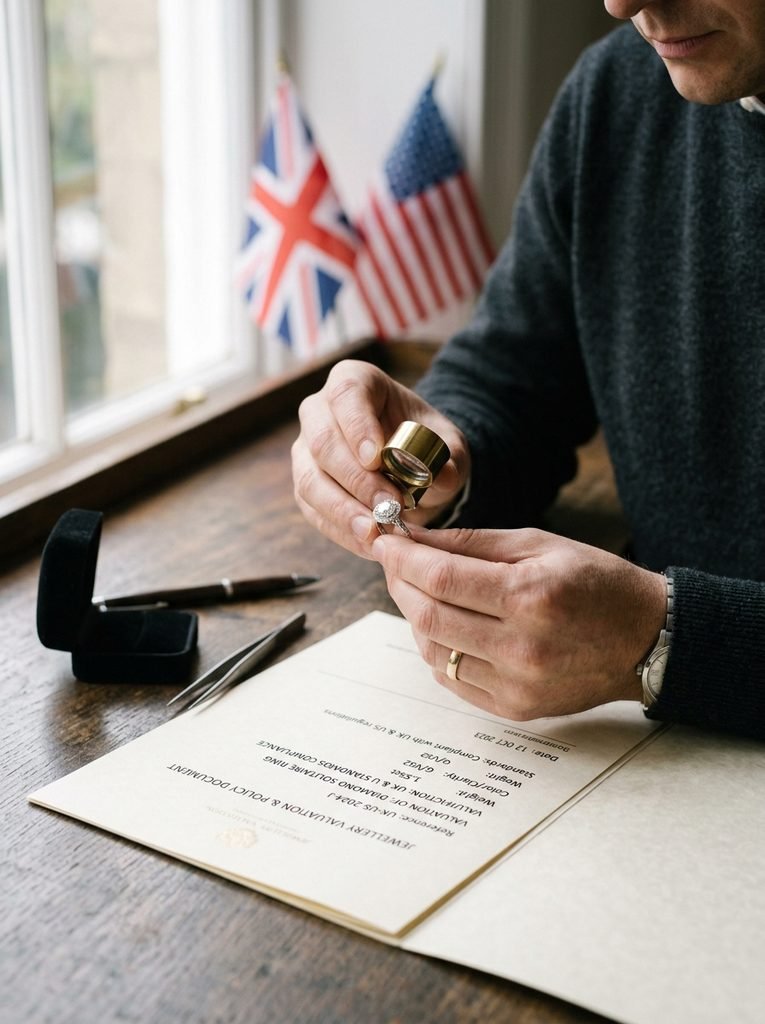
Make a record of the pieces you intend to insure. Include a clear description, photographs from multiple angles, purchase receipts if available, and any appraisal or grading documents. For gemstones, note details such as carat weight, cut, colour, clarity, metal, maker, and identifying marks when known.
Then compare the inventory with the policy schedule. Each listed piece should be recognizable from the description, and its limit should be realistic for repair or replacement. If you own several pieces, check whether the policy has a combined jewellery limit in addition to individual-item limits.
Review the inventory when you:
- Buy, inherit, or receive a valuable piece.
- Have an item repaired, redesigned, or upgraded.
- Move to another country or change your main residence.
- Start wearing a piece regularly outside the home.
- Receive a new appraisal or notice a substantial market change.
An outdated schedule can leave a gap even when the item is technically listed.
Understand Appraisals And Valuations
An appraisal can document what a piece is, describe its materials, and estimate value for insurance purposes. It is not necessarily the same as a resale offer or the amount you would receive in a private sale. Replacement values can also change over time.
Ask the insurer what documentation it accepts and when it requires an updated appraisal. Do not assume every item needs a formal appraisal before cover begins: some providers accept a detailed description and estimated value below specified thresholds, while others set different requirements. Chubb’s UK and US product pages, for example, describe their own conditions for jewellery valuations; those thresholds are product-specific and should not be generalized.
If you are moving between the UK and US, ask whether the insurer will continue cover at your new address. A policy that was valid for a UK resident may not be available or equivalent after relocation, and eligibility for some US specialist policies depends on residence.
Read The Exclusions And Conditions
Exclusions are not fine print to ignore; they define the situations where the insurer will not pay. Common areas to inspect include:
- Gradual wear, deterioration, or maintenance problems.
- Intentional damage or dishonest claims.
- Loss while the item is unattended or left in an unsecured location.
- Theft by someone in the household or a person invited into the home.
- Unexplained disappearance if the policy does not include it.
- Travel duration or destination restrictions.
- Failure to notify the insurer of a newly acquired high-value item.
- Claims above the policy limit or outside the listed description.
The NAIC advises consumers to review their policy limits and consider scheduled property when ordinary homeowners coverage is insufficient. UK insurers similarly set their own terms, limits, and exclusions in policy documents. No national label overrides those details.
What To Do If Jewellery Is Lost, Stolen, Or Damaged
Act promptly and follow the insurer’s claims process. The specific deadlines and evidence requirements are policy-dependent, but these steps are generally useful:
- Protect people first. If a theft or robbery has just occurred, move to safety and contact local emergency services if needed.
- Report theft to the appropriate police service. Keep the report or reference number.
- Tell the insurer as soon as the policy requires. Ask what evidence and forms are needed.
- Gather records. Provide photos, receipts, appraisals, repair records, and the policy schedule.
- Keep damaged items and paperwork. Do not authorize major repairs or dispose of pieces before the insurer explains its process.
- Record conversations and decisions. Note dates, names, claim references, and any requested documents.
- Review the settlement. Check how the insurer applied the limit, excess or deductible, and valuation basis.
If the claim is denied or the amount seems inconsistent with the policy, ask the insurer to explain the decision in writing and identify the relevant wording. Complaint routes differ by country and by the type of policy, so use the official process applicable to your insurer and location.
How To Choose Between A Home Add-On And A Specialist Policy
A home-policy extension may be convenient if the jewellery is part of a broader household contents package and the limits suit your needs. A specialist policy may be worth comparing if you need broader protection for accidental loss, worldwide travel, a high-value collection, or terms that differ from your standard home policy.
Compare these points side by side:
- Total annual premium, including any policy add-ons.
- The insured value for each piece and for the collection as a whole.
- Theft, accidental damage, accidental loss, and disappearance.
- Cover at home, away from home, and abroad.
- The deductible or excess.
- Repair and replacement arrangements.
- Appraisal and documentation rules.
- Conditions for travel, storage, and security.
- How a claim may affect the wider home-policy premium or renewal.
Do not buy a policy solely because it advertises “all risks” or “worldwide” protection. Ask for the policy wording and confirm what those terms mean in the contract.
Action Plan
- ☐ List each piece and its current estimated replacement value.
- ☐ Find the jewellery limits in your existing contents, homeowners, or renters policy.
- ☐ Confirm which valuable items must be specifically named.
- ☐ Check whether cover includes accidental loss, disappearance, and damage.
- ☐ Confirm protection outside the home and during international travel.
- ☐ Compare the excess or deductible with the value of likely claims.
- ☐ Ask how claims are settled and what evidence is required.
- ☐ Update the insurer after purchases, moves, or major value changes.
Key Takeaways
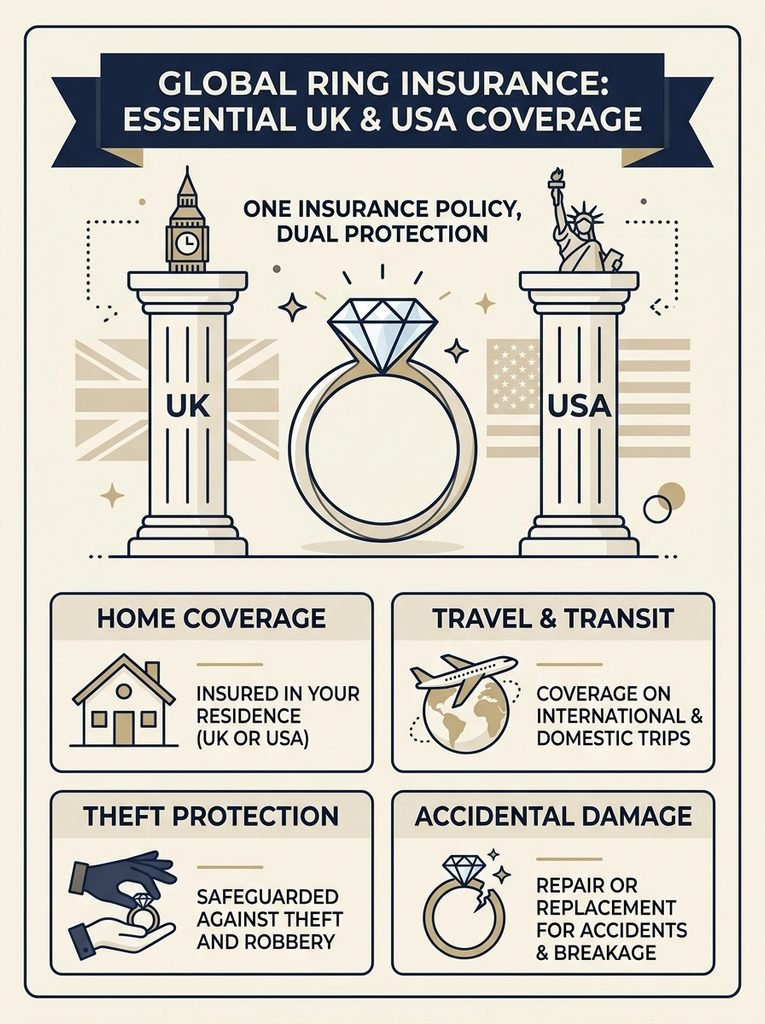
- UK jewellery cover often begins with contents insurance, while US cover often begins with homeowners or renters insurance.
- Both systems can limit jewellery cover under a standard household policy.
- Away-from-home, worldwide, accidental-loss, and accidental-damage protection may require additional or specialist cover.
- Country-level generalizations are only a starting point; the policy schedule and wording decide what applies to you.
FAQ
Is jewellery automatically covered by home insurance in the UK?
Jewellery may be included as contents, but limits and insured events vary. High-value items may need to be specified, and protection outside the home may require personal possessions or away-from-home cover. Check the schedule and policy wording for item limits, total valuables limits, accidental damage, and exclusions.
Does US homeowners insurance cover a lost engagement ring?
A standard policy may cover some jewellery losses, especially certain theft claims, but it may apply a special limit and deductible. Accidental loss or unexplained disappearance may not be included. A scheduled personal property endorsement or a specialist policy may provide broader protection, depending on its terms.
Does jewellery insurance cover items while travelling abroad?
Some policies offer worldwide cover, while others limit protection to the home or require an add-on. Travel duration, unattended items, hotel storage, checked baggage, and destinations can affect cover. Confirm the details with the insurer before relying on the policy during a trip.
Do I need an appraisal to insure jewellery?
Not always. Requirements vary by insurer, item value, and policy type. Some providers may accept a detailed description and estimated value for lower-value pieces, while others require appraisals at particular thresholds. Ask the insurer what documentation it requires and when values should be updated.