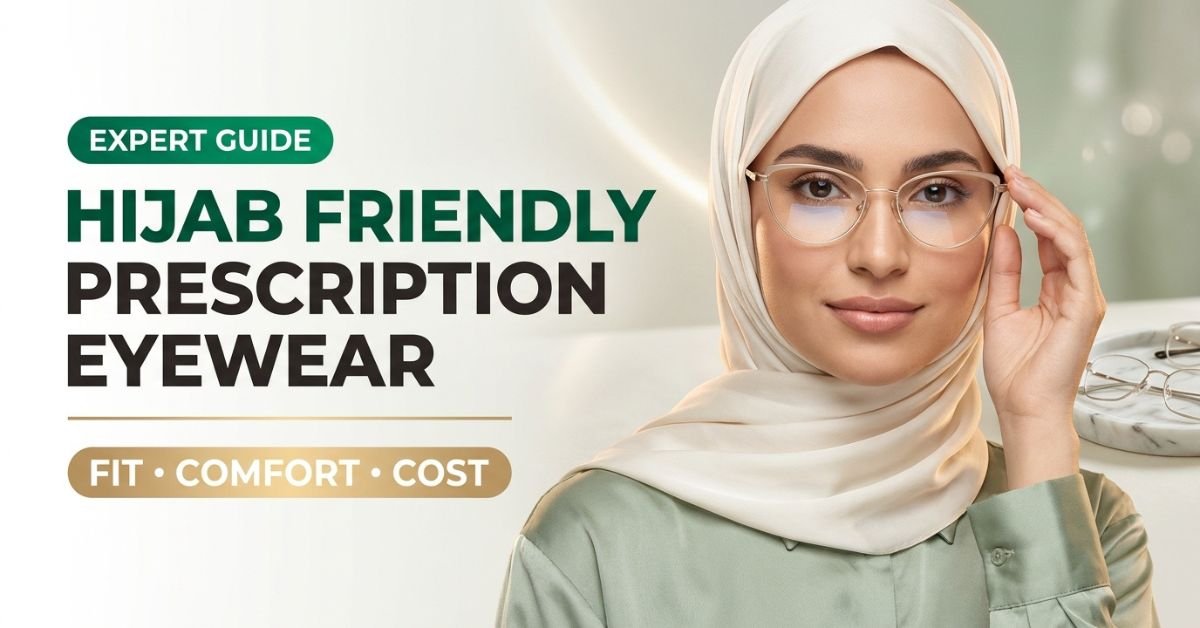
Hijab Friendly Prescription Eyewear: Fit Comfort and Cost
Walk into almost any optical shop and you’ll see people doing the same thing: holding frames up to their faces, turning left and right, judging the shape. For a woman who covers her hair, that ritual skips the most important part. Hijab friendly prescription eyewear succeeds or fails at the sides of the head, where the arms meet the fabric. A frame can look perfect from the front and still pinch your ears by lunchtime, push your scarf out of place, or leave a line along your wrap that you keep smoothing all day.
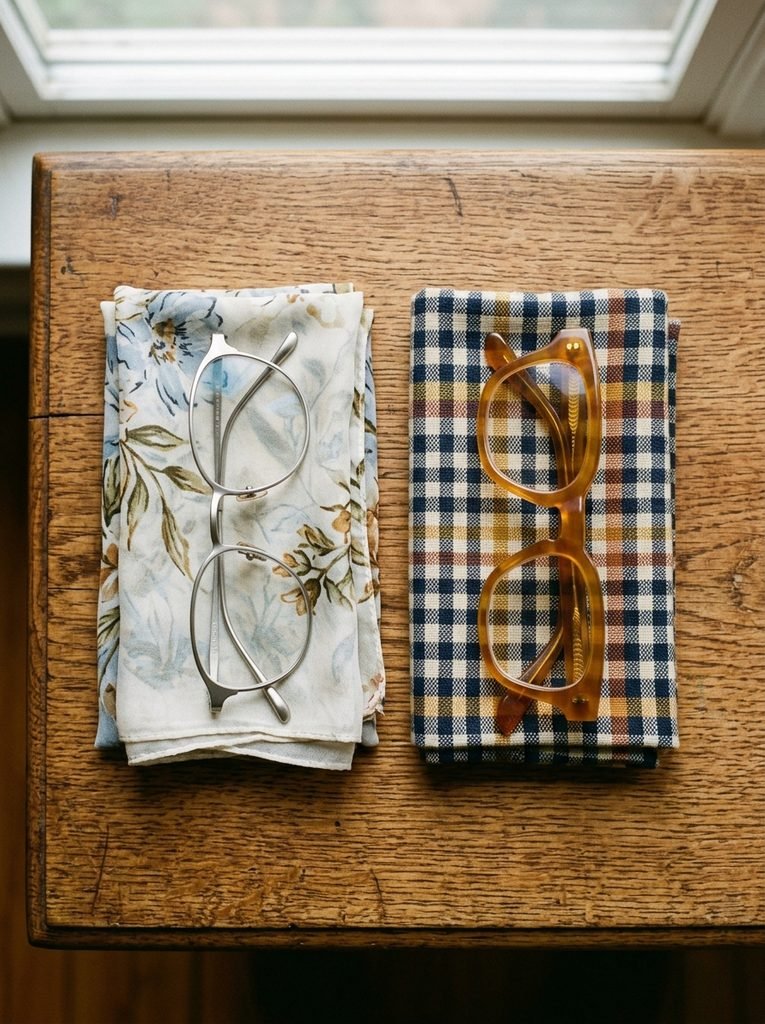
This guide compares the two frame families most hijab wearers end up choosing between: slim metal (usually titanium or stainless steel) and acetate. It looks at how each one behaves under fabric, how it feels after a long day, and what you can expect to pay, whether you shop in Jakarta, Toronto, Lagos, Dubai or Manchester.
Quick Answer
Hijab friendly prescription eyewear combines thin, straight arms (usually 140–150 mm), a lightweight frame—titanium often weighs half as much as acetate—and adjustable nose pads that hold position without pressing through fabric. A complete single-vision pair ranges from roughly $20 at budget online labs to $200 or more at full-service opticians.
Key Takeaways
- Judge the arms before the front. Thin, straight arms disappear under a scarf; thick ones create ridges and pressure.
- Titanium is the comfort pick for long days. Acetate offers more colour and a warmer, bolder look.
- Sensitive skin needs more than a “hypoallergenic” sticker. Ask what the nose pads and arm tips are made of too.
- Prices vary hugely by country, but the pattern is the same everywhere: the lenses, not the frame, usually drive the final bill.
- Progressive or multifocal lenses depend on precise measurements, so an in-person fitting is worth paying for.
Titanium Vs Acetate Frames: The Side-By-Side Table
| What Matters | Slim Metal / Titanium | Acetate |
|---|---|---|
| Arm profile under fabric | Fine and flat, easy to cover | Often broader, may show through thin scarves |
| Typical weight | Very light, often under 20 g | Noticeably heavier, often 25 g or more |
| Nose fit | Usually adjustable pads on small arms | Usually a fixed bridge moulded into the frame |
| Skin comfort | Excellent if the metal is genuinely nickel-free | Comfortable for most people |
| Adjustment | Pads and arms bent with small tools | Arms softened with gentle heat and reshaped |
| Long-term wear | Flexes and returns to shape | Can loosen, warp in heat, or snap if forced |
| Look | Minimal, metallic, understated | Colourful, patterned, statement-making |
These weights are broad averages, not rules. A delicate acetate frame can weigh less than a heavy steel one. As a general guide, though, the table holds up well, and each row matters more once a hijab is part of the picture.
Fit Under The Hijab: Temple Profile And Length
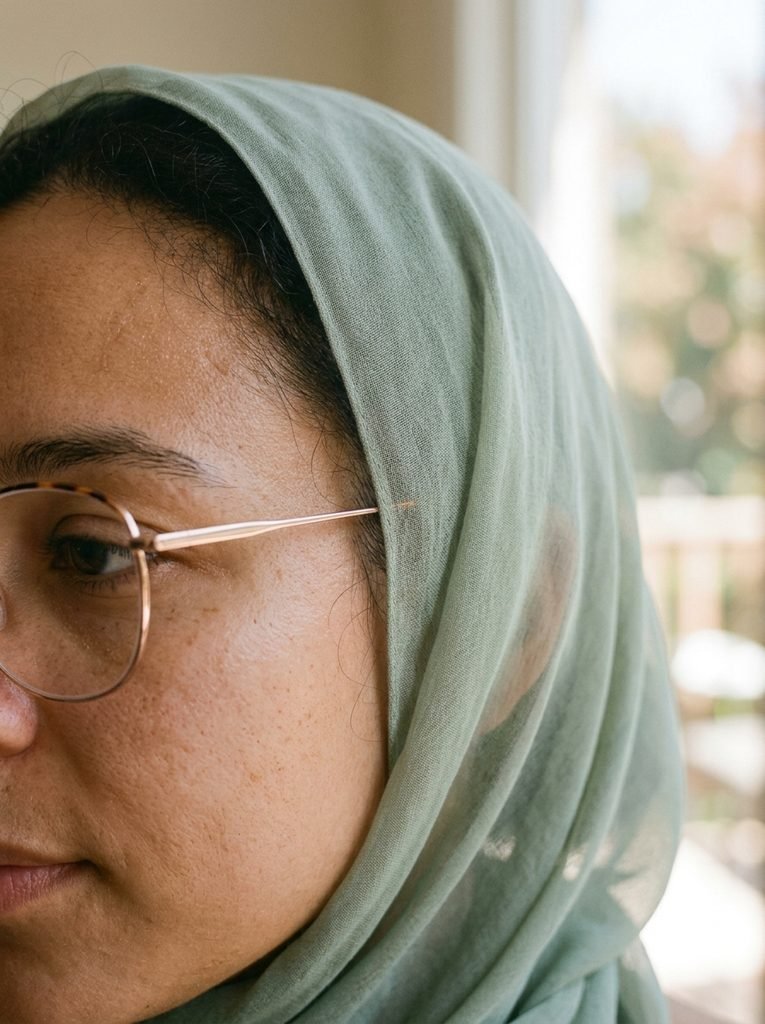
The temple, the arm running from the hinge to behind your ear, is where the scarf and the glasses meet. Every problem hijab wearers describe starts there: the ache above the ear, the frame lifting when the fabric is pinned, the bump visible through a smooth jersey wrap.
Thin metal arms cause the fewest of these problems. They sit close to the skull, so fabric passes over them cleanly and the pressure is spread along a narrow line instead of a wide band. Semi-rimless and rimless designs take this further by removing weight and hardware from the edges altogether, although they need gentler handling.
Acetate still has a place. Many modern acetate frames use a thick front with arms that taper sharply after the hinge, which gives you the bold look where people see it and a slimmer profile where your scarf covers it. When you shop online, look at the side-view photo, not just the front.
Glasses Temple Length: Reading The Three Numbers On Your Frame
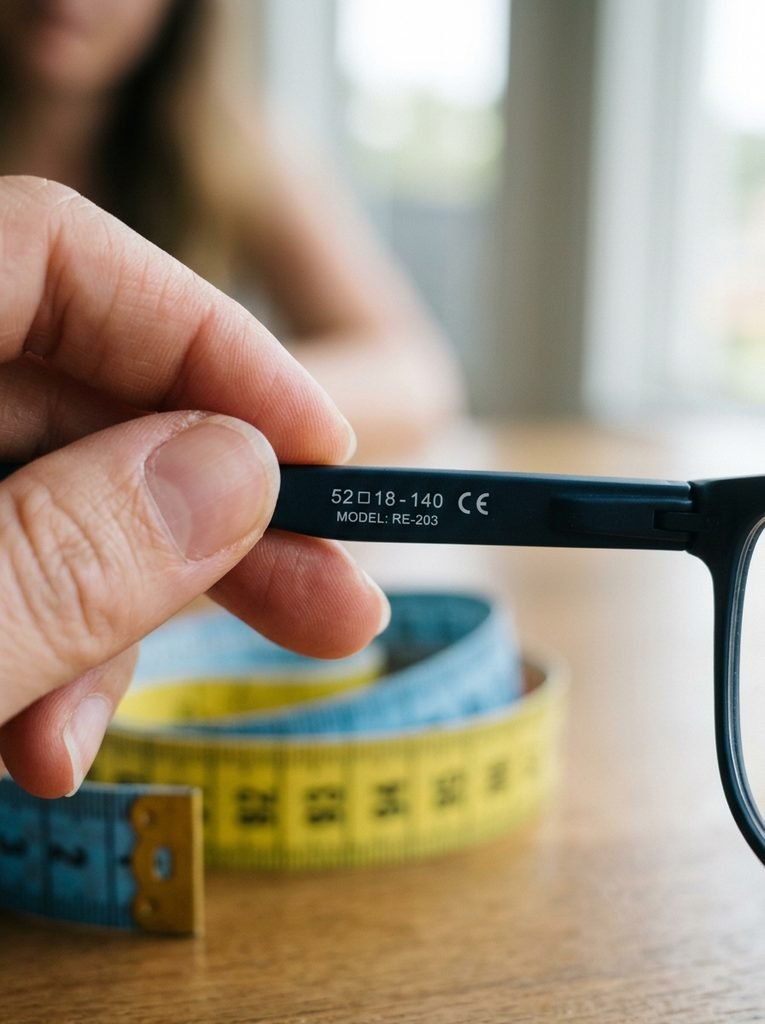
Most frames have three small numbers printed inside one arm, something like 50-18-145. The first is the width of one lens, the second is the gap across the bridge of the nose, and the third is the arm length. All three are in millimetres.
Arm length usually comes in steps of five, most often between 135 and 150. For hijab wearers, this number deserves extra attention. Fabric wrapped around the ear adds thickness, and an arm that ends too early will ride up over that extra layer instead of curving down behind the ear. That’s why many women who wear a scarf find a 145 or 150 mm arm more secure than the length they’d choose bare-headed.
The practical rule is simple. Take the three numbers from the most comfortable pair you’ve ever owned and use them as your baseline. Staying within a couple of millimetres on each measurement keeps the fit predictable. And whenever possible, try new frames on with your usual underscarf and hijab already in place.
Glasses Under The Hijab, Between Layers Or Over: Where The Arms Go
There’s no single correct method. The right choice depends on your fabric and how tightly you wrap.
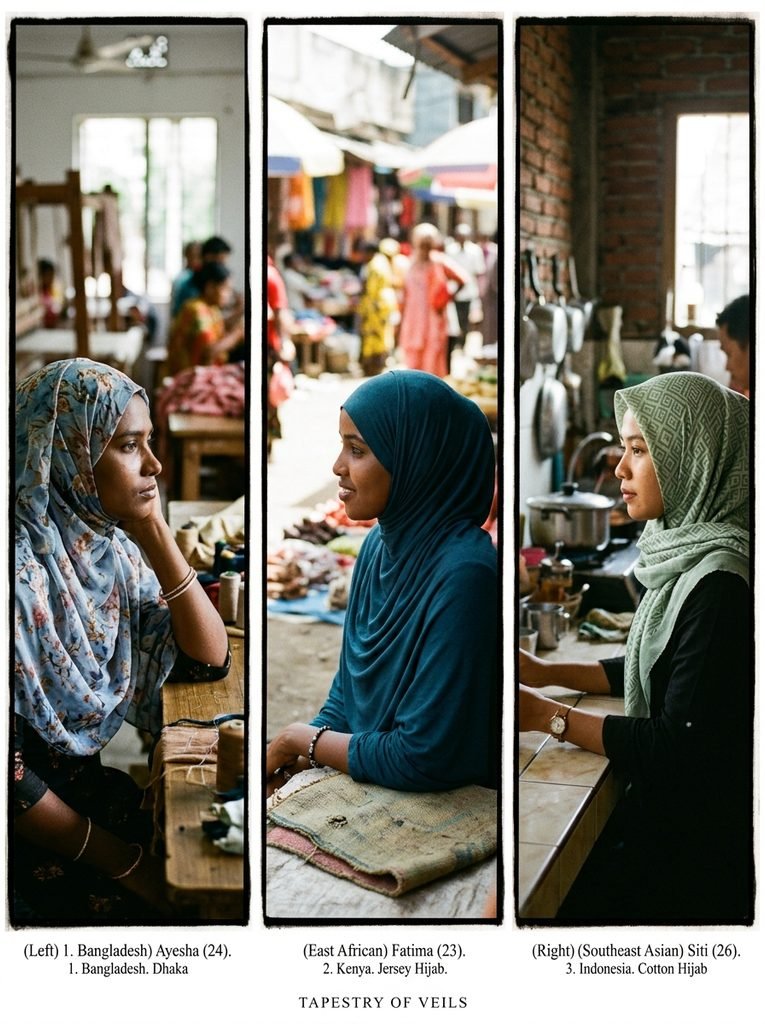
- Under the fabric works best with smooth, slippery materials like chiffon, georgette or silk-like blends. The scarf holds the arms in place instead of letting them slide.
- Between layers suits women who wear a snug underscarf. The arms rest on the cap, while the outer scarf covers them without adding pressure.
- Over the fabric works with textured, grippy materials such as cotton, linen or jersey, which stop the arms from slipping forward.
If you tuck your glasses underneath, pin with a little slack around the ears. A wrap pulled tight over a metal arm presses it into the head all day.
All-Day Comfort: Weight, Nose Pads And Pressure Points
Frame weight is easy to dismiss in a shop and hard to ignore at the end of a workday. Every gram rests on two points, the bridge of your nose and the tops of your ears, and a scarf adds steady pressure to the second. A heavy frame under fabric can leave red marks on the nose and a dull ache behind the ears that only fades after the glasses come off.
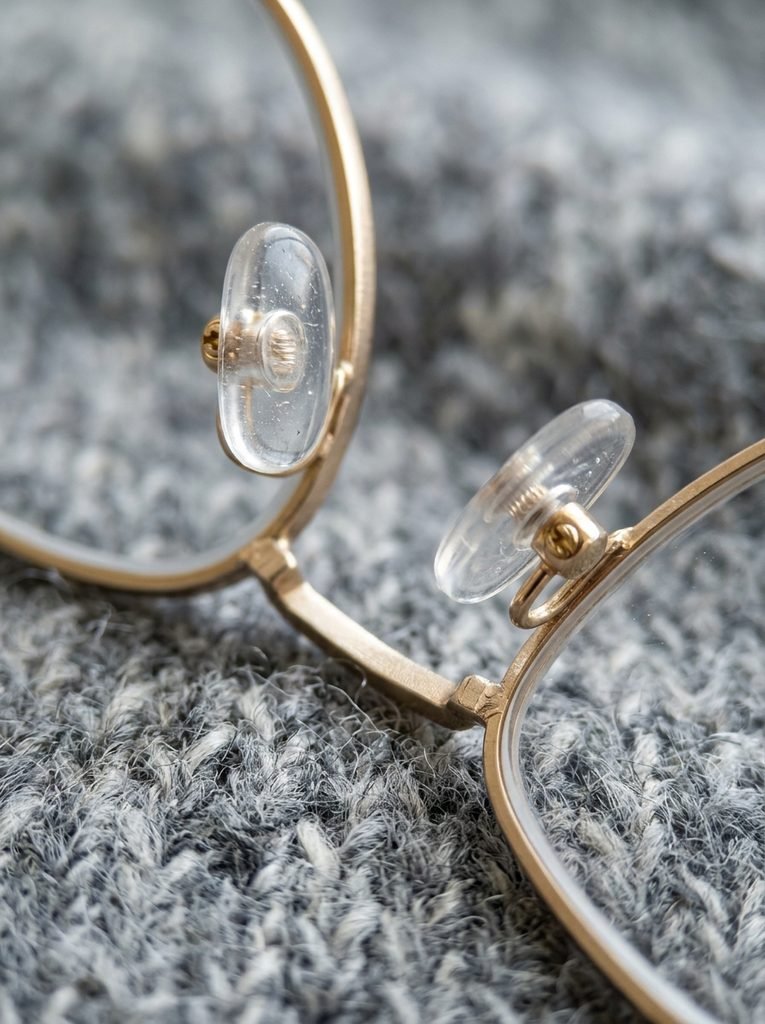
Nose pads make a real difference. Metal frames usually sit on two small cushions mounted on thin wire arms. An optician can bend those arms to raise the frame, lower it, or change its angle, which is useful because readjusting glasses under a hijab means disturbing the whole wrap. Pads that hold their position mean fewer adjustments through the day.
Acetate frames usually have a fixed bridge. If it matches your nose, it’s comfortable and stable. If your nose bridge is low or narrow, which is common across many parts of Asia, Africa and the Middle East, a fixed bridge may let the frame sit too low, with the lenses brushing your cheeks when you smile. Some brands make low-bridge or “Asian fit” acetate styles with raised pads built in, and they’re worth asking about.
Try this before you buy. Put the frames on over your normal hijab, look down at the floor, then turn your head quickly from side to side. A good fit stays put. If the frame slides forward, the arms are too short, the bridge is too wide, or both.
Skin, Fabric And Allergy Considerations
A covered head holds warmth and moisture around the temples and ears, which is exactly where the frame touches your skin. Minor sensitivities that go unnoticed in open air can turn into itching or redness under a scarf.
Nickel is the most common problem. Many inexpensive metal frames contain it, even when the listing just says “metal”. Titanium is naturally gentle on skin, but not every frame sold as titanium is pure titanium. Some are blends with other metals mixed in. If you’ve reacted to jewellery or watch backs before, ask specifically for pure or beta titanium and get it confirmed in writing on the product details.
Don’t forget the small parts. Nose pads, screws and the plastic sleeves over the arm tips all touch your skin, and a skin-friendly frame paired with cheap pads can still irritate.
Acetate agrees with most people. Occasional reactions usually come from lower-grade material or surface finishes rather than acetate itself, so a well-made frame from a reputable seller is the safer choice.
Then there’s the fabric. Sharp hinge corners and protruding screws catch delicate scarves and pull threads loose over time. Run a fingertip over the hinge area in the shop. If it catches your skin, it will catch your chiffon.
Adjustability And Durability Over Months Of Wear
Glasses worn with a hijab get handled more than most. They come off to fix the wrap, go back on over the pins, and get pushed through fabric at odd angles. Over months, that handling shows.
Good titanium copes well. It bends under pressure and returns to shape, shrugs off sweat, and keeps its alignment for years with basic care. The downside is that major reshaping takes skill and the right tools, so it’s a job for an optician rather than a kitchen-table fix.
Acetate is easier to reshape and harder on mistakes. An optician can warm the arms and mould them around your ears for a custom curve, which suits some head shapes very well. But acetate can loosen over time, soften if left in a hot car or on a sunny windowsill, and crack if it’s bent sharply when cold. Frequent on-and-off handling also wears the hinge area faster.
Your Prescription Changes The Equation
The frame is only half the weight you carry. Stronger prescriptions need thicker lenses, and thick lenses are heavy, especially at the edges for short-sightedness and in the centre for long-sightedness. Put heavy lenses in a heavy frame and the comfort problems above get much worse.
A few principles help:
- Keep the lenses modest in size. Oversized shapes look striking but need more lens material, which means more weight and thickness.
- Consider thinner lens materials if your prescription is strong. They cost more, but they make a visible and physical difference.
- Pair a strong prescription with a light frame. This is where titanium earns its price.
Progressive and multifocal lenses are the most demanding. They contain separate zones for distance, mid-range and reading, and those zones must line up precisely with your pupils. A few millimetres off and you’ll spend weeks tilting your head to find a clear spot. Ask the optician to take the measurements while you’re wearing your hijab exactly as you normally do, because the way the scarf sits can change how the frame rests on your face.
Adjustable nose pads help here as well. They let the optician raise or lower the frame in small steps until the lens zones fall exactly where they should.
Hijab Friendly Prescription Eyewear Cost: What You’ll Actually Pay
Glasses prices vary widely between countries because of currency, taxes, labour costs and local competition. The ranges below are rough guides in US dollars, not quotes, but the pattern holds almost everywhere.
| Where You Buy | Complete Single-Vision Pair (Approx.) | Progressives (Approx.) | Trade-Off |
|---|---|---|---|
| Budget online labs | $20–$60 | $50–$150 | Very low prices, little or no personal fitting |
| Chain stores and direct-to-consumer brands | $80–$200 | $200–$400 | Good balance of price, selection and service |
| Independent and designer opticians | $200–$500+ | $400–$800+ | Premium frames, detailed fitting and aftercare |
Budget Online Labs
Online sellers offer the lowest prices by cutting out the shop, the stylist and the fitting chair. For a simple prescription and a frame size you already know, they can be excellent value, and many hijab wearers buy a backup pair this way. The risk is fit: nobody adjusts the pads or arms for you, and returns can take weeks, especially if you order from another country.
Chain Stores And Independent Opticians
Mid-range chains and direct-to-consumer brands suit most people. They usually include basic lens coatings, offer free adjustments, and let you try frames on with your hijab before you commit. Independent and designer opticians charge more, but you pay for time: careful measurements, a wider choice of premium materials, and someone who will reshape your frame properly six months later.
Insurance, Public Health Schemes And Employer Benefits
Before you pay full price, check what support you already have. Many countries offer help with eye tests or glasses through public healthcare, especially for children, older adults, students or people on low incomes. Private health and vision insurance plans often include a yearly or two-yearly allowance for frames and lenses. Some employers also cover eyewear for staff who work long hours at screens. The rules differ everywhere, so ask your optician or provider what applies to you.
Where The Extra Money Goes
The frame rarely makes a pair expensive. The bill usually grows because of:
- Pure titanium or premium acetate instead of basic materials
- Thinner lens materials for strong prescriptions
- Progressive or multifocal lens designs
- Add-ons such as anti-glare coatings, light-reactive tints and screen filters
Which Should You Choose
If you wear glasses from morning to night and tuck them under an underscarf: Choose slim titanium with adjustable nose pads and arms around 145–150 mm. It’s the lightest, least visible option under fabric.
If you wear loose wraps or cotton scarves and keep your glasses on top: Acetate works well here. Look for tapered arms and a bridge shaped for your nose.
If metal has irritated your skin before: Stick to confirmed pure titanium or good-quality acetate, and check the pads and arm tips as well.
If your prescription is strong: Choose smaller lenses, ask about thinner lens materials, and keep the frame as light as you can.
If you need progressives or multifocals: Buy in person, and make sure you’re measured while wearing your hijab the way you usually do.
If you’re watching your budget: Get your main pair properly fitted, then order a budget backup online using that pair’s three frame numbers. Check any insurance, employer or public-health support first.
Your Next Steps
- Read your numbers. Find the three measurements inside your most comfortable pair and write them down.
- Decide on arm placement. Choose under, between or over based on the scarf fabric you wear most often.
- Shop with your hijab on. Wear your usual underscarf and wrap when trying frames, both in store and at home.
- Run the movement test. Look down and turn your head quickly. If the frame slides, change the arm length or bridge size.
- Confirm the materials. If you have sensitive skin, ask for pure titanium or quality acetate and check the pads too.
- Price your real prescription. Get a quote with your actual lens needs, not just the advertised frame price.
- Use free adjustments. Go back after a week of wear if anything presses, slips or rubs. Small tweaks make a big difference.
Frequently Asked Questions
Are rimless glasses a good option with a hijab?
They can be. Rimless styles are very light and have little hardware at the sides, so they sit comfortably under fabric. Their weakness is durability: the lens mounts can loosen if the glasses are taken on and off roughly.
Why do my glasses slip when I wear a hijab?
The usual causes are arms that are too short to reach past the extra fabric, a bridge that’s too wide for your nose, or arms resting on a slippery scarf. Longer arms, adjustable pads, or tucking the arms under the fabric usually solve it.
Are there hijab styles made for people who wear glasses?
Yes. Some ready-to-wear and instant hijabs have small openings at the sides so the arms of your glasses can pass through without lifting the fabric.
Does vision insurance or a public health scheme cover hijab friendly frames?
Coverage depends on the plan, not the frame style. If your plan includes glasses, you can usually choose any eligible frame and pay the difference if it costs more than your allowance.
Is titanium worth paying extra for?
For anyone who wears glasses all day under a scarf, it usually is. It’s lighter, slimmer at the sides, resistant to sweat and long-lasting. If you only wear glasses occasionally, a well-fitted acetate frame may be all you need.