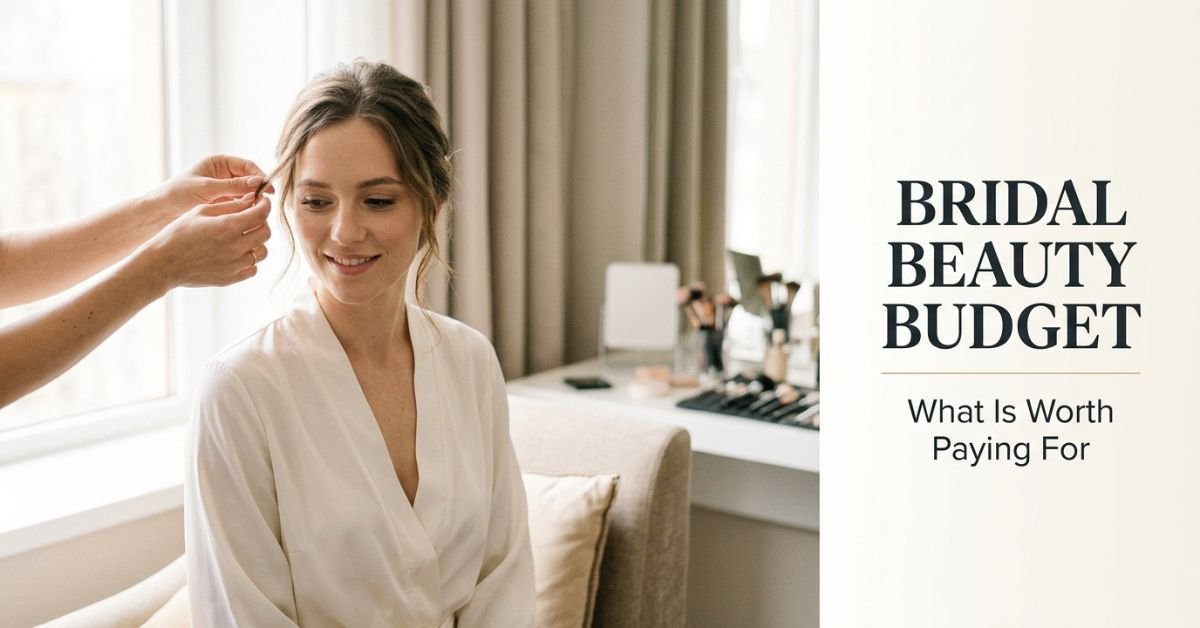
Bridal Beauty Budget: What Is Worth Paying For And What Is Not
The error repeats itself in almost every country and every price bracket. A bridal beauty budget gets divided like a dinner bill — a share for hair, a share for skin, a share for nails, a share for lashes, a share for a tan — until every service is funded and none of them is funded well. The result is a morning full of small purchases and an album that quietly shows it.
Your wedding is not a photoshoot lasting twenty minutes. Depending on where you live, it may run one long day or stretch across three or four separate events, in heat, under artificial light, and in front of a camera that never stops. That is the only environment your money has to perform in.
Quick Answer: Where Should Your Bridal Beauty Budget Go?
Direct most of your bridal beauty budget toward the hair and makeup artist working on the day itself, plus the trial that confirms their work. Those choices appear in every photograph. Reduce or remove nails, tanning, pre-packaged bridal kits and rushed final-month treatments. Skincare deserves funding, but only when begun months ahead.
By The Numbers
- 60–70% — the share of a beauty budget that reasonably belongs to the day-of artist and the trial
- 1 — the number of services visible in every single frame of your wedding gallery
- 8–16 hours — how long the work must hold, longer again for multi-event weddings
- 3–6 months — the minimum runway before skincare produces a visible change
- 2–4 — the number of separate looks a multi-day wedding demands, and the number most budgets forget to plan for
Key Takeaways
- Hair and makeup is not one item among many. It is the item, and it earns a disproportionate share.
- The trial is not a luxury add-on. It is the only real safeguard on your largest beauty expense.
- Anything visible only in close-up detail shots returns very little for what it costs.
- Timing governs value more than price does. Late money buys almost nothing.
- Multi-day celebrations and bridal party glam are the two places where budgets silently double.
The Full Comparison: Worth It Vs Not Worth It At A Glance
Because currencies and salon rates differ enormously between countries, the cost column below uses a portable benchmark: one unit = the price of a standard blow-dry at a mid-range salon in your own city. Whether that unit is small or large where you live, the ratios hold remarkably steady across markets.
| Line Item | Relative Cost | Verdict | Reasoning |
|---|---|---|---|
| Wedding-day makeup artist | 6–15 units | Worth paying for | Visible in every frame, for the entire day |
| Wedding-day hairstylist | 5–12 units | Worth paying for | Must survive heat, movement, embracing, dancing |
| Trial for hair and makeup | 2–5 units | Worth paying for | Removes the only unfixable risk you face |
| Skincare begun early | 4–12 units total | Worth paying for | Improves the surface everything else sits on |
| Brow shaping and tinting | 1–2 units | Worth paying for | Defines the face in every close portrait |
| Additional hair pieces | 2–7 units | Situational | Necessary for certain styles and finer hair |
| Lash extensions | 3–7 units | Situational | Applied lashes achieve a near-identical result |
| Second look for later events | 2–5 units | Situational | Essential for multi-day weddings, optional otherwise |
| Elaborate nail work | 2–4 units | Not worth it | Present in a handful of detail images |
| Tanning treatments | 1–3 units | Not worth it | Unpredictable under camera flash |
| Clinical teeth whitening | 8–20 units | Not worth it | Gradual home methods close most of the gap |
| Ready-made bridal emergency kit | 2–5 units | Not worth it | Familiar items sold at a considerable markup |
| Intensive treatments in the final month | 5–12 units | Not worth it | Arrives too late to help, early enough to cause harm |
Use this table to rank your spending, then attach your own local prices to it. The ranking is what travels; the numbers are not.
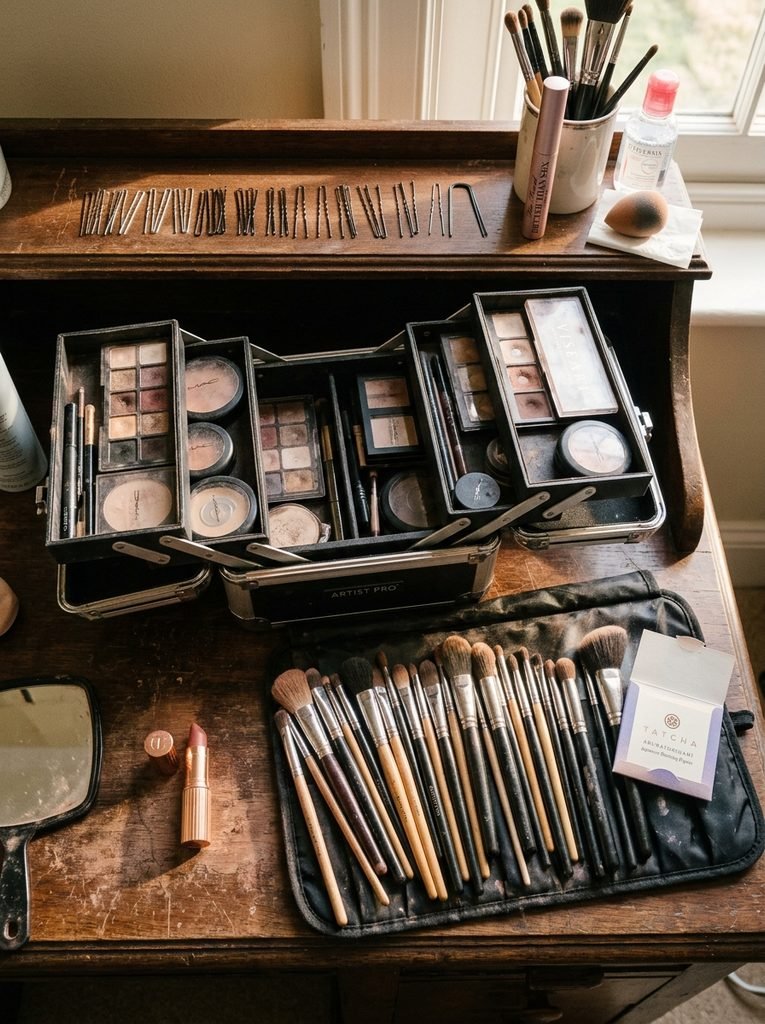
Hair And Makeup: The One Expense That Earns Every Unit
If your budget could stretch to a single service, this would be it, and nothing else comes close.
It helps to understand what the fee actually covers. Not simply an application — you can apply makeup yourself. You are paying for work that reads correctly through a photographer’s flash, through afternoon daylight and through warm evening lighting, that holds while you cry and while you dance, and that still looks like your own face rather than a costume. Achieving all four at once is a genuine technical skill.
There is a second thing you are buying, and it matters more internationally than most guides admit: specificity. An artist experienced with your hair texture and your skin depth will produce a better result at a modest price than a celebrated artist without that experience will produce at a high one. Coily and tightly curled hair, very fine straight hair, deeper skin tones, mature skin, and hijab-friendly styling all require particular knowledge. Before comparing fees, compare portfolios for people who look like you.
What each level of the market usually delivers:
| Tier | What You Typically Receive |
|---|---|
| Entry (4–6 units) | Newer artist, competent work, narrow product range, little margin for problems |
| Standard (6–10 units) | Established artist, products tested for longevity, trial often credited to the total |
| Senior (10–16 units) | Highly experienced artist or a small team, on-site touch-ups, faster mornings |
| Premium (16+ units) | Reputation, editorial-level finish, and a premium attached to sought-after dates |
The step from entry to standard is the one worth taking. The step from senior to premium is largely a name, and names do not appear in your album.
Where to trim without regret: request itemised pricing rather than a package. Bundles frequently include a second look, a standby hour and party services you may not want. Separating them out often reclaims a meaningful sum while changing nothing about how you look as you walk in.
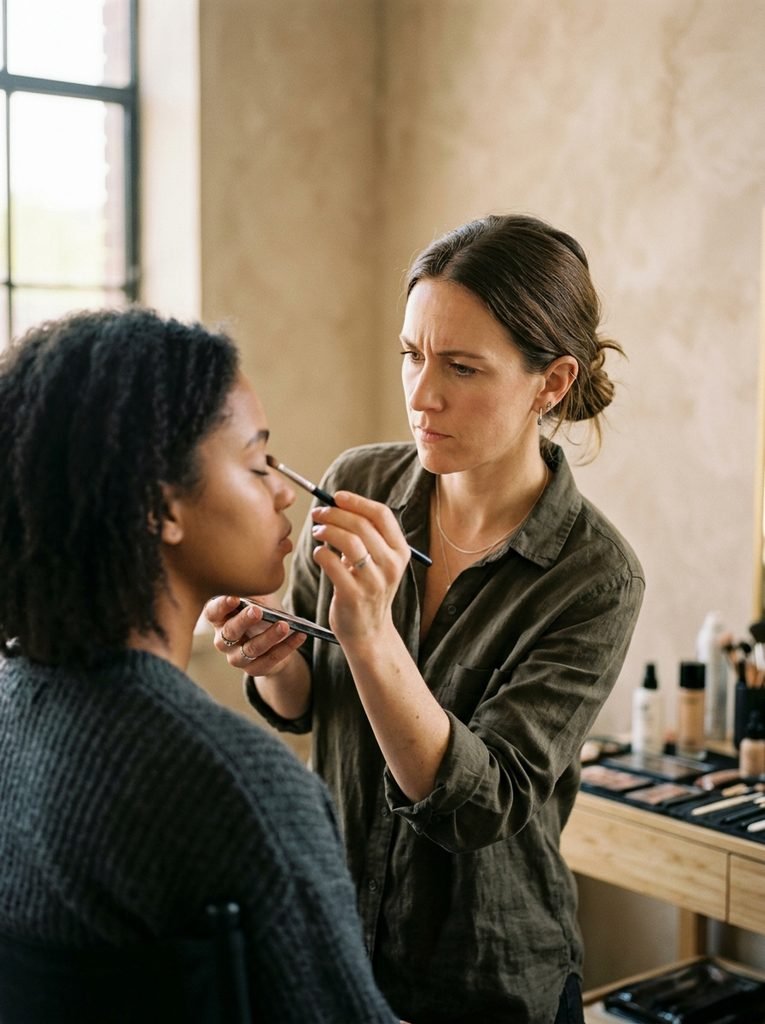
The Wedding Makeup Trial: Modest Cost, Serious Protection
This is the first line brides delete. It is the worst deletion available to them.
A trial costs a small fraction of the day-of fee and removes the one scenario nobody recovers from: sitting in the chair on the morning of the wedding, seeing a stranger in the mirror, and having no hours left to change it.
How to make a trial genuinely useful:
- Schedule it on a day with plans afterward. You need to watch the work age across many hours, not admire it for ten minutes.
- Photograph the result three ways — with flash, in daylight and under indoor lighting. Skin that looks flawless to the eye can turn flat or ashen through a lens.
- Wear something close to the colour of your wedding outfit. White, ivory, red and gold each pull the eye differently and change how a face reads beside them.
- Bring references for what you dislike as well as what you admire. Artists work faster from a clear negative than from a vague ideal.
- Note down every product used on your base. That list becomes your touch-up kit later.
A disappointing trial costs you the trial fee and saves the wedding. That trade is always worth making.
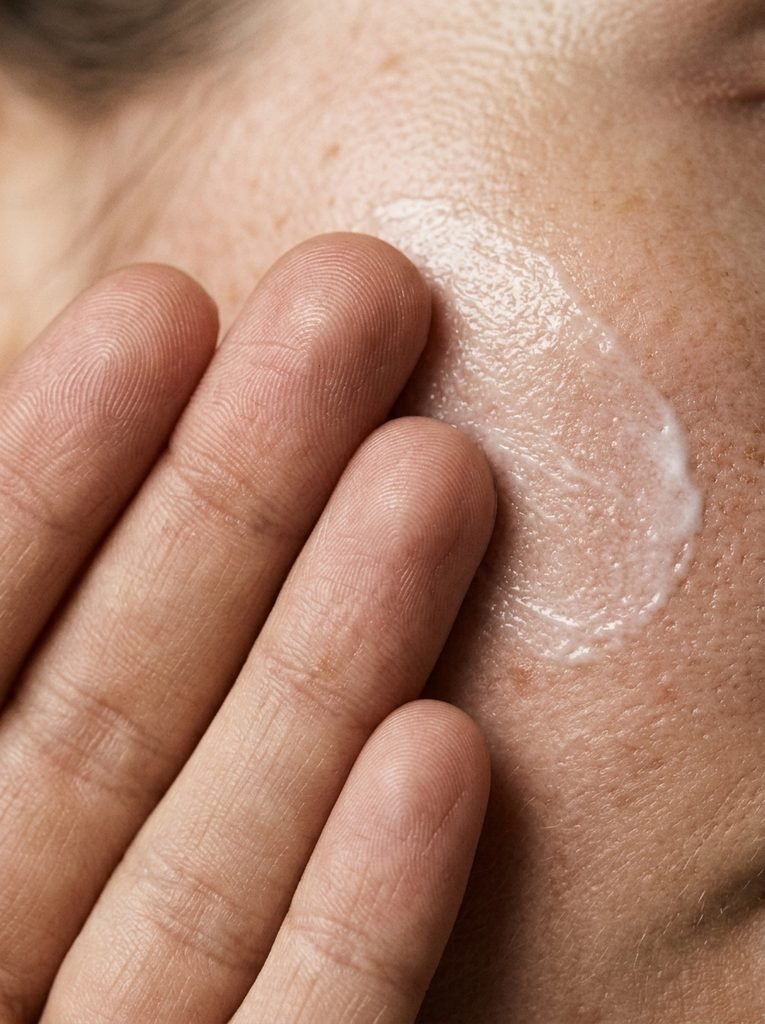
Skin Prep: Worth Funding, But Only If You Start Early
One rule determines whether skincare money works: skin improves on its own timetable, and your wedding date has no influence over it.
Spending on skin half a year out is among the highest-return decisions in a bridal beauty budget, because it upgrades the surface every other product must sit on. Foundation over well-prepared skin looks like skin. The same foundation over irritated or neglected skin looks like foundation.
Spending in the final few weeks inverts that logic. It costs the same and introduces genuine risk. An aggressive treatment close to the date can leave you concealing something that did not exist before you paid for it.
Bridal Skincare Prep Timeline
| Time Before The Wedding | What Genuinely Helps | What To Avoid |
|---|---|---|
| 6–12 months | Specialist consultation for persistent concerns, prescribed actives, a consistent routine | Nothing — this is the window for anything ambitious |
| 3–6 months | Regular facials, gentle exfoliation, daily sun protection, targeted treatment | Introducing a strong new active late in this window |
| 1–3 months | Maintenance only, hydration, stability | New brands, new formulas, new clinics |
| 2–4 weeks | One gentle hydrating facial at most | Peels, extractions, needling, anything untried |
| Final week | Water, sleep, moisturiser, sun protection | Everything else, without exception |
The most expensive mistake in this category is booking an intensive course of treatments that begins six weeks before the wedding. That schedule captures almost none of the benefit while carrying nearly all of the risk.
Brows: A Small Spend With Outsized Return
Shaping and tinting costs less than almost anything else on this list and alters the entire architecture of the face in close portraits.
The timing rule from skincare applies again. Book your shape three to four weeks ahead so there is room for anything to grow back. Never allow a new brow shape in the final week, and never let the day-of artist meet your natural brow for the first time on the morning itself.
Worth paying for. Simply not on the wrong date.
Lash Extensions Versus Applied Lashes: A Near Coin Flip
Extensions cost several times what a quality set of applied lashes costs, usually require a top-up before the wedding, demand particular aftercare, and occasionally irritate eyes that have never objected to anything before.
Lashes applied by your artist on the morning photograph almost identically, come off that night, and carry no risk at all.
Choose extensions only if you already wear them, already know your eyes tolerate them, and want to travel immediately afterward without doing eye makeup. In that narrow case they justify themselves. Otherwise the camera cannot tell the difference.
Bridal Nails: The Most Overfunded Line On The List
Nails appear in ring photographs, in a few shots holding flowers, and in a small handful of detail frames. That is the full extent of their exposure.
A neat manicure in a restrained shade covers that job entirely. Extensions and intricate artwork add cost and add fragility — a lifted or chipped nail two days before the wedding becomes an urgent problem that a simple manicure would never have created.
Not worth paying for. Redirect the difference to the trial.
Tanning Treatments: High Risk, Low Reward
This is the service most likely to go wrong and least likely to improve a photograph.
Tanning formulas interact unpredictably with perspiration, with deodorant, with certain fabrics and with the oils in some makeup bases. Colour that appears convincing in a bathroom mirror can read orange under flash, and it can transfer onto pale fabric at exactly the wrong moment.
If you tan routinely, know your formula and always patch test, the risk falls sharply. If you have never had one, the week of your wedding is the worst possible time to begin.
Not worth paying for in most cases. A light body luminiser applied on the day gives you the glow and none of the exposure.
Hair Pieces And Extensions: Situational, And Worth Getting Right
Certain styles cannot be built without added density. Long flowing waves, substantial traditional updos, elaborate braided work and half-up styles on fine hair all depend on it.
If your chosen look requires it, this is functional spending rather than indulgence — and it belongs in the trial, so the stylist can match colour and blend properly. Arriving on the morning with unfamiliar hair pieces is a dependable way to lose an hour you did not have.
If your style does not require it, it contributes nothing.
Teeth Whitening: The Slow Route Wins
The visible difference between clinical whitening and consistent home whitening over several weeks is narrower than the price difference implies, and both carry the same warning — sensitivity is common and peaks immediately afterward.
Begin a gradual approach two to three months out, stop a week before, and move the saving toward your artist.
Not worth the premium for most brides.
Bridal Party Hair And Makeup Cost: Where Budgets Silently Double
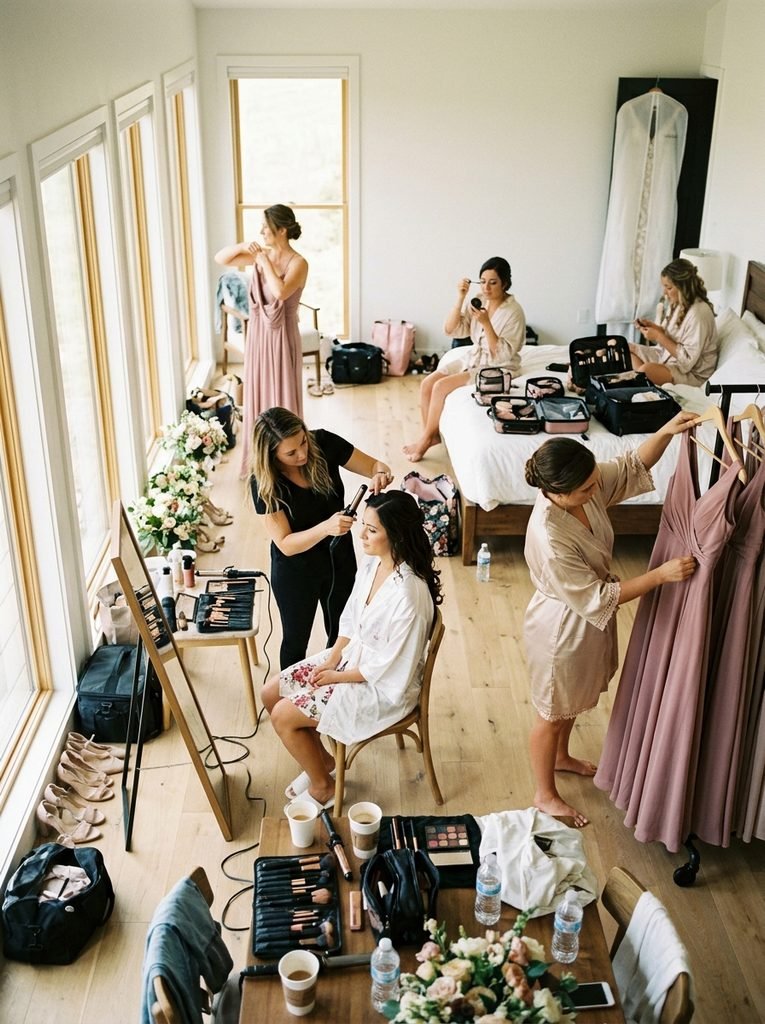
A bride books her artist and feels entirely in control of the number. Six attendants are then added at a per-person rate, and the beauty budget has more than doubled without a single deliberate decision.
Multi-day weddings compound this further, since each event may require its own round for the same group.
Three honest ways to handle it:
- Cover yourself only. Attendants arrange and pay for their own. This is ordinary in most places — state it early, before anyone books anything.
- Cover a base level. You pay for everyone’s hair; makeup is theirs to add if they want it.
- Negotiate a group rate. Most artists reduce per-person pricing beyond four or five people and bring an assistant, which also shortens the morning considerably.
The failure is leaving it unspoken until the final month, when the discomfort of raising it makes you absorb the cost by default.
The Touch-Up Kit: Assemble It, Do Not Purchase It
Pre-packaged bridal emergency kits are a margin exercise. Inside you will find blotting papers, a lipstick, pins, a stain remover and a mirror, priced well above what those items cost individually.
Build your own from what the trial taught you:
- The exact lip colour your artist used
- Blotting papers rather than powder, which is kinder to a photographed face
- A folding brush and a compact mirror
- Pins matched to your hair colour, plus a small hairspray
- A stain pen, clear deodorant and tissues
- Painkillers, plasters for shoes, safety pins and a hair tie
Hand it to one person whose only responsibility is holding it. That is the entire system.
Not worth paying for in packaged form.
Which Should You Choose Beauty Budgets By Bride
If your budget is tight: Fund the artist and the trial and nothing else. Do your own nails, skip tanning, use applied lashes, assemble the kit yourself. A small budget concentrated on two services outperforms the same amount scattered across seven.
If your budget is moderate: Fund hair, makeup and the trial properly at the standard tier. Add early skincare and a brow appointment. Contribute to the bridal party only if doing so does not force you to downgrade your own artist.
If your budget is generous: You can support the senior tier, a second look, hair pieces and a group rate for your attendants. Even so, sequence matters — fully fund the day-of team before adding anything optional.
If your wedding runs across several days: Budget per event rather than per wedding, and negotiate a multi-event rate with one artist rather than booking each separately. Continuity across events is worth more than variety, and a single artist who already knows your face works faster on day three than a new one does on day one.
If you rarely wear makeup: Spend less overall and concentrate it on the trial. Your risk is not underspending; it is being handed a face you do not recognise. Two trials with an artist who works in a natural register serves you better than one with a specialist in heavy glamour.
If you are marrying somewhere hot or humid: Prioritise an artist who works in that climate regularly over one you would need to fly in. Products that hold perfectly in dry, cool conditions can fail within hours in heat, and travel costs usually exceed whatever premium a strong local artist charges.
If your date falls in peak season: Book earliest rather than cheapest. Availability, not price, becomes the binding constraint once the season fills.
The Rule Underneath All Of It
Rank every possible expense by a single question: how many photographs does this appear in?
Hair and makeup appear in all of them. Skin appears in all of them. Brows appear in every close portrait. Nails appear in a few frames. A tan appears mainly as a colour cast someone may need to correct afterward. A shop-bought kit appears in none of them at all.
That ranking is your budget. The rest is detail.
What To Do Next
- Decide your total beauty figure before contacting a single vendor.
- Assign 60–70% of it to the day-of artist and the trial, and defend that share.
- Book the artist first, and prioritise portfolios showing your hair texture and skin depth.
- Schedule the trial for a day with plans afterward, and photograph the result three ways.
- Begin skincare now if you are more than three months out, and stop introducing anything new inside four weeks.
- Settle the bridal party payment question this month rather than next season.
- If your wedding spans multiple days, price every event now, not the main one only.
- Assemble your touch-up kit from the trial’s product list and give it to one person.
FAQ
How Much Should A Bride Budget For Hair And Makeup?
Because salon rates vary so widely between countries, a proportion works better than a figure. Aim to direct roughly two-thirds of your total beauty budget toward the day-of artist and the trial, and expect the combined cost to land somewhere between six and fifteen times what a standard blow-dry costs in your own city.
Is A Wedding Makeup Trial Really Necessary?
For nearly every bride, yes. It is the only chance to see how a look photographs and how it ages across a full day while there is still time to change direction. Many artists apply the trial fee to the final total, which makes it cheaper than it first appears.
When Should I Book My Bridal Hair And Makeup Artist?
Nine to twelve months ahead for popular dates, and around six months for quieter periods. Sought-after artists fill early, and the limit you encounter is usually availability rather than cost.
Should I Pay For My Bridesmaids’ Hair And Makeup?
There is no obligation, and covering only yourself is entirely normal in most places. What matters is deciding early and saying so plainly, because an undefined arrangement tends to become your expense by default.
Can I Do My Own Wedding Makeup To Save Money?
It is workable if you already apply your own makeup confidently and photograph well in it. Run a full-day rehearsal with flash photography first, invest in a long-wearing base and setting products, and arrange for someone else to manage touch-ups so you are not tending to your own face between events.
What Is The Most Common Bridal Beauty Budget Mistake?
Dividing the money evenly. Funding seven services at a basic level reliably produces a poorer result than funding two of them properly, because those two appear in every photograph and the others appear in almost none.