
Importing Abayas And Modest Wear: Duty, Shipping And Suppliers
There is one error almost every new modest-wear seller makes, and it happens before a single order is placed. They receive a quotation, see a low figure next to each style, compare it against the retail price they have in mind, and conclude the margin is enormous.
That figure is not your cost. It is the opening line of a longer bill.
Between a supplier’s cutting table and your shelf sit freight charges, customs duty, consumption tax, handling fees and a growing list of compliance obligations. Sellers who price from the quotation alone usually discover the gap after the goods arrive, when the money has already gone.
Quick Answer: Importing abayas costs considerably more than the quoted unit price. Once customs duty, consumption tax, international freight, clearance charges and inland delivery are added, most importers find their true cost per piece lands between 1.4 and 2 times the supplier’s figure, depending on destination and shipping method.
What follows are the nine decisions that determine whether the margin you imagined survives the journey.
Classify The Garment Before You Price Anything
Every country that collects import duty uses the same international classification system at its first six digits. Within that system, garments are separated by how they are made and what they are made from, not by cultural name or intended wearer.
A flowing, woven, single-piece abaya will usually fall under the heading covering women’s dresses and ensembles, then be narrowed further according to whether the fabric is synthetic, artificial, cotton or wool. Open-front kimono cuts, layered sets and prayer garments sometimes belong instead to the broader heading for other garments. Anything made from knitted or jersey fabric moves to an entirely different chapter with its own rates.
The difference is financial, not theoretical. Two abayas that look identical on a hanger can carry noticeably different duty because one was woven and the other knitted.
Protect yourself with two habits:
- Insist on a written fibre composition for every style. Terms like crepe, nida or jazz describe weave and finish, not fibre content, and customs does not accept them as a composition.
- For styles you intend to reorder in volume, apply for an advance or binding classification decision from your national customs authority. Most offer this, most offer it free, and the decision removes any later dispute about which rate applies.

Find Your Real Duty Rate For Each Destination
Your duty depends on the tariff code, the country the goods were manufactured in, and the country they are entering. Change any one of the three and the number changes with it.
| Factor | What it decides |
|---|---|
| Tariff code | The base rate published in your national tariff schedule |
| Country of origin | Whether a trade agreement lowers or eliminates that rate |
| Country of import | The schedule itself, plus any additional national levies |
As a working range, apparel duty across major importing markets tends to sit somewhere between zero and thirty-five percent. Several Gulf and Middle Eastern markets apply a modest flat rate across most goods. Many European markets cluster around the low double digits. Some markets in Asia, Africa and Latin America apply considerably higher protective rates on finished garments. A number of countries charge nothing at all on clothing.
Trade agreements can wipe the rate out entirely, but only if you can prove origin. That means a valid certificate or declaration of origin from the manufacturer, issued for the specific consignment. A supplier saying “we are in a free trade country” is worth nothing at the border without the paperwork.
One habit worth building: check the live rate before each shipment rather than trusting a figure you noted last season. Tariff schedules are revised, trade agreements come into force, and temporary measures appear and expire without much warning.
Understand How Low Value Parcel Rules Are Changing Worldwide
For years, many modest-wear sellers avoided importing altogether. They listed products online, forwarded orders to a supplier, and let individual parcels cross borders below whatever value threshold applied locally. Below that line, duty was often waived and paperwork was minimal.
Governments have spent recent years reconsidering that arrangement. The reasoning is consistent from country to country: parcel volumes grew enormously, domestic retailers argued they were being undercut by goods entering untaxed, safety regulators found that low-value imports were harder to inspect, and treasuries noticed how much revenue was passing through untouched.
The result is a broad international shift. Thresholds are being lowered, replaced with flat per-item charges, or removed completely. Where the exemption survives, it increasingly comes with data requirements that make casual shipping impractical, and platforms are being made responsible for collecting tax at checkout.
For your planning, the safest assumption is this: build your business as though every parcel will eventually attract duty and tax, because in most markets it either already does or soon will. Sellers who consolidate stock into commercial shipments and clear it properly are increasingly in the stronger position one clearance, one set of documents, predictable cost per unit.
Add Consumption Tax On Top Of Duty
This surprises almost everyone in their first year. Whether your market calls it VAT, GST, sales tax or something else, the taxable base is usually not the invoice value alone. It is the goods plus the cost of getting them to the border, plus the customs duty just applied.
The mechanics matter more than the label:
- A consignment worth 4,000 with 600 in freight and 550 in duty is typically taxed on 5,150, not on 4,000.
- Rates vary widely. Some markets charge nothing on imports of this kind, several Gulf states apply a low single-digit rate, most of Asia-Pacific and Europe fall between five and twenty-five percent, and a few exceed that.
- Registered businesses in many countries can reclaim or offset this tax through their normal returns, which turns it into a cash-flow issue rather than a cost. Unregistered sellers absorb it permanently.
If you are importing regularly and your country offers voluntary registration below the compulsory threshold, run the numbers. For many small modest-wear importers, registering pays for itself within two or three consignments.
Agree The Incoterm Before Money Moves
Suppliers quote in shorthand, and buyers rarely ask what the shorthand excludes.
- Ex Works. The lowest headline price and frequently the highest final one. You become responsible from the factory door, including export formalities in the supplier’s own country — something that is difficult to arrange from abroad.
- Free On Board. The supplier delivers to the departure port and handles export clearance; you take over from there. For sea freight, this is the sensible default.
- Cost, Insurance and Freight. The supplier arranges main carriage. Convenient, though you lose control over carrier choice and often pay more than you would arranging it yourself.
- Delivered Duty Paid. Goods arrive at your door with everything paid. The cost of that convenience is buried in the unit price, and there is a compliance dimension worth understanding: the declaration is still made in your name.
That last point deserves emphasis. If anyone declares your goods at less than you actually paid in order to reduce duty, the legal exposure attaches to you as the importer, not to the person who filled in the form. Undervaluation is the most common compliance failure in this category and one of the most heavily penalised. Declare what you paid.
Match The Shipping Mode To The Order Size
| Mode | Typical transit | Rough cost per piece | Suits |
|---|---|---|---|
| Express courier | Under a week | High | Samples, urgent replenishment, very small orders |
| Air freight | One to two weeks | Moderate | Launch quantities and seasonal top-ups |
| Sea freight | Four to seven weeks | Low | Proven sellers ordered in volume |
| Road or rail | Varies | Low to moderate | Regional sourcing within the same landmass |
There is a quirk specific to this product category that catches people out. Abayas are light but bulky. International carriers charge on whichever is greater, actual weight or volumetric weight, and folded garments in poly bags almost always take up more space than their weight justifies. A carton weighing twelve kilograms can easily be billed at twenty.
Two ways to reduce it: ask for carton dimensions before accepting any freight quote, and ask whether the supplier can compress or vacuum-pack. Better packing can cut an air freight bill by a third without touching the unit price.
Seasonality is the other planning constraint. Demand across most modest-wear markets peaks sharply around Ramadan and Eid, with a secondary lift around wedding seasons that differ by region. Sea freight plus clearance can consume two months. Work backwards from the date customers want the product, then add a fortnight of slack.
Vet Modest Wear Wholesale Suppliers Properly
| Region | Strengths | Trade-offs |
|---|---|---|
| Turkey | Strong design, quick delivery into Europe and the Gulf, small minimums are common | Higher unit cost than East Asia |
| Gulf states | Authentic regional styling, premium fabrics, strong finishing | Highest prices; many sellers are traders rather than manufacturers |
| East Asia | Lowest unit cost, full customisation, large capacity | Higher minimums, longer lead times, wider quality variance |
| Southeast Asia | Growing modest-wear manufacturing, competitive pricing, strong local design sense | Export experience varies between factories |
| South Asia | Outstanding embroidery and hand finishing, flexible quantities | Consistency depends heavily on the individual workshop |
| Regional makers in your own market | No import formalities, fast restocking, easy communication | Higher cost, limited customisation |
Whichever region you pick, apply the same tests. Ask how many pieces the factory produces in a month, and treat a vague answer as a sign you are speaking to an intermediary. Ask for photographs or a live video walkthrough of the production floor rather than a catalogue. Ask how long they have been exporting and to which countries. Check that the bank account you are asked to pay belongs to the registered business and not to an individual.
Structure payment in stages wherever possible a deposit to begin production and the balance against inspection or shipping documents. A supplier confident in their own work rarely objects.
Buy Samples And Write A Spec Sheet
Order from at least three suppliers before committing to anyone, and assess each sample against the same checklist: fabric weight and drape, opacity under bright light, colour stability after washing, interior seam finishing, sleeve and hem measurements against the sizes you were promised, and the quality of zips, press studs or buttons.
Opacity deserves separate mention because it is the leading cause of returns in this category and the one attribute that photographs never reveal. Hold the fabric against a window before you decide anything.
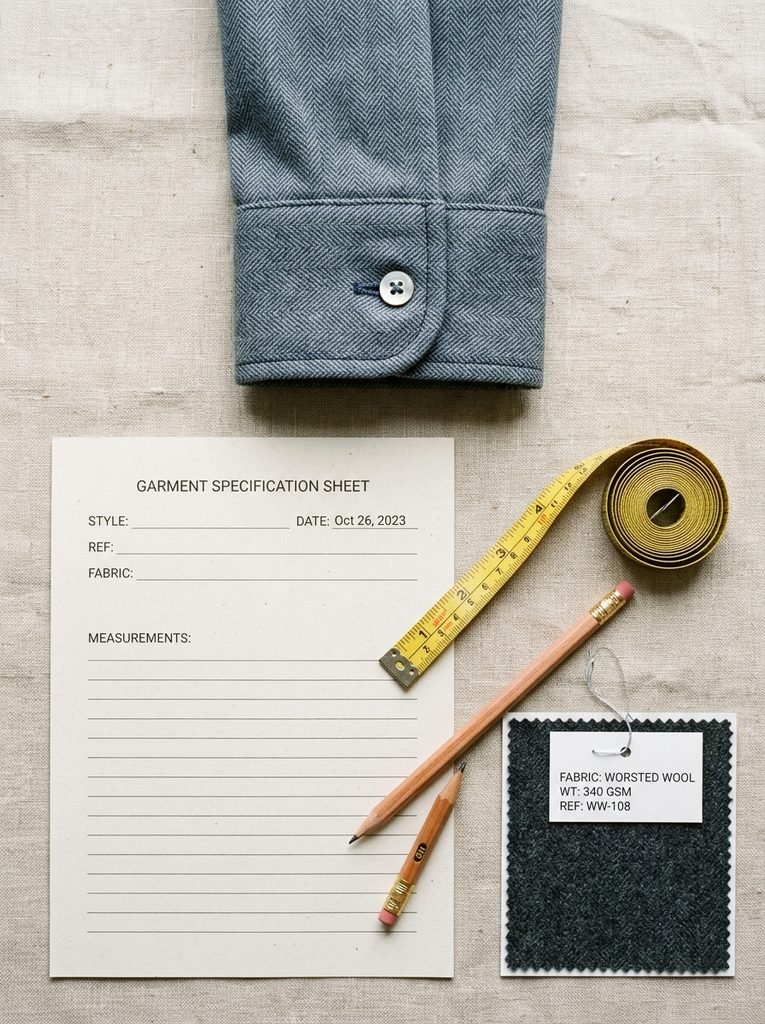
Then commit the specification to paper. Fibre composition, fabric weight, full measurement chart for every size, thread colour, label type and placement, folding and packing method, carton quantity. Attach that document to the purchase order and reference it in your payment terms.
Without a spec sheet, “the bulk order doesn’t match the sample” is your opinion against theirs. With one, it is a documented breach you can act on.
For larger orders, arrange an independent pre-shipment inspection. It costs a fraction of the consignment value and is considerably cheaper than storing goods you cannot sell.
Meet Labelling And Compliance Rules In Your Market
Requirements differ by country, but the recurring themes are consistent enough to plan around:
- Fibre composition must normally be shown on a permanently attached label, often in the official language or languages of the destination.
- Care instructions are mandatory in many markets and expected by customers in all of them.
- Country of origin marking is commonly required on the garment itself, not only on the carton.
- Business identification — the name or registered identifier of the importer, manufacturer or responsible party — is increasingly required so that consumers and regulators have someone to contact.
- Supply chain documentation is being requested more often, particularly for cotton and blended fabrics, with the burden of proof sitting on the importer rather than the authorities.
Sort labelling out before production finishes, not after arrival. Relabelling a shipment in a bonded warehouse is expensive; relabelling it at the factory costs almost nothing.
Finally, keep your records. Invoices, packing lists, origin documents, transport papers and proof of payment should be archived for whatever period your customs authority specifies. Post-clearance audits are routine in many countries and often arrive years after the goods have been sold.
What This Actually Costs: A Worked Example
A retailer orders 200 abayas at 12 per piece, delivered to the departure port.
| Line | Amount |
|---|---|
| Goods (200 × 12) | 2,400 |
| Freight, origin charges and insurance | 520 |
| Customs duty at 12% (on goods plus freight) | 350 |
| Consumption tax at 15% (on goods, freight and duty) | 490 |
| Clearance, brokerage and handling | 95 |
| Inland delivery | 50 |
| Total outlay | 3,905 |
| Cost per piece | 19.53 |
| Cost per piece if consumption tax is reclaimable | 17.08 |
The quotation said 12. The real number is between 17 and 19.50 depending on your tax position somewhere between 42 and 63 percent above the figure on the proforma.
Set your retail price from the bottom of that table. Never from the top.
Key Takeaways
- The supplier’s unit price typically represents around 60 to 70 percent of your true landed cost.
- Duty follows the tariff code, and the tariff code follows fabric and construction, not product name.
- Origin determines whether a trade agreement helps you, and only documented origin counts.
- Consumption tax is usually charged on goods plus freight plus duty, so the charges compound.
- Low-value parcel exemptions are shrinking internationally; plan as though duty will apply.
- Abayas are billed on volumetric weight far more often than on actual weight.
- A written specification is what turns a quality complaint into an enforceable claim.
- Labelling failures stop shipments that are otherwise perfectly declared.
Your Next Steps
- Identify the tariff code for your three strongest styles, using written fibre compositions from the supplier rather than marketing descriptions.
- Look up your national duty rate for each of those codes and record the date you checked it.
- Confirm how consumption tax is calculated in your country and whether your business can reclaim it.
- Rebuild your pricing sheet with goods, freight, duty, tax, clearance and inland delivery as separate lines.
- Request samples from three suppliers across two regions so you are comparing sourcing strategies, not just vendors.
- Write your specification document and attach it to every purchase order from now on.
- Diarise a quarterly review of import rules for your market. This area is moving quickly and will keep moving.
Frequently Asked Questions
How much duty will I pay on abayas?
It depends on your tariff code, the country of manufacture and the country of import. Across major markets, apparel duty commonly falls somewhere between zero and thirty-five percent, with many countries in the low double digits. Check your own national tariff schedule for the exact figure.
Do I need a licence to import abayas?
In most countries, no. Clothing is rarely a restricted category. You will normally need a business registration and an importer or customs identification number, plus correct labelling for the destination market.
Which region is cheapest to source from?
East Asia usually offers the lowest unit price with the highest minimums. Turkey and Southeast Asia sit in the middle with better design flexibility. Gulf suppliers command the highest prices for premium finishing. Once freight, duty and inventory holding costs are added, the gap between them narrows considerably.
What minimum order quantity should I expect?
Anywhere from none to several hundred pieces per style. Smaller wholesalers frequently accept mixed low-quantity orders; manufacturers offering full customisation and private labelling almost always set higher minimums.
Can I still ship single parcels to customers without paying duty?
Increasingly not. Low-value exemptions are being reduced or withdrawn across many markets, and where they remain they carry growing data and reporting obligations. Consolidated commercial shipments are becoming the more predictable route.