Clothing Manufacturers: MOQ, Cost Per Unit And How To Vet
Choosing clothing manufacturers becomes difficult when every quotation appears to describe a different product. One supplier offers a surprisingly low price. Another accepts smaller orders but charges more per garment. A third wants payment for development before confirming the final production cost.
The temptation is to choose the cheapest offer and resolve the details later.
That approach leaves the most expensive questions unanswered. What materials are included? How many pieces must you buy in each colour? Will the finished garments match the sample? What happens if part of the delivery cannot be sold?
A useful comparison starts with the product, continues through the complete order budget, and finishes with evidence that the supplier can deliver what has been agreed.
Quick answer: Compare clothing manufacturers against one written product specification. Confirm how minimum quantities apply, calculate the complete order cost, and assess representative samples. Check who receives payment, who performs production, and who resolves problems. Approve measurable quality requirements before authorising the full batch.
By the numbers — an illustrative example
240 garments planned · Two colours · Four sizes · One opening collection
This article follows a fictional clothing business called Harbour Thread. Its order quantities, prices, and production outcomes are invented to explain purchasing decisions. They are not market averages or quotations from real suppliers. Dollar amounts serve only as a common calculation unit; the same reasoning works in any currency.
Key takeaways
- A minimum order may apply separately to each style, colour, or material.
- A lower unit price can require a much larger overall commitment.
- Samples need to demonstrate fit, construction, and intended materials.
- Supplier identity and production capability require separate checks.
- Written specifications make quality discussions more precise.
- Reorder decisions should reflect sales and product performance.
A new clothing label defines what it actually needs
Harbour Thread wants to introduce a relaxed adult overshirt. The founder has a clear visual idea: two neutral colours, four sizes, and discreet branding.
However, a visual idea is not yet a production specification.
The first supplier interprets the design as a lightweight shirt. The second quotes a heavier garment with reinforced pockets. The third proposes adapting an existing pattern.
Their prices differ partly because they are imagining different products.
Before requesting another quotation, the founder prepares a written brief covering fabric composition, intended weight, measurements, pocket construction, buttons, stitching, labels, and packaging.
The brief also explains which services are required. Harbour Thread needs help creating the pattern and developing its size range. It does not want to discover halfway through the project that these services were excluded.
This distinction matters when comparing manufacturing models.
A supplier decorating ready-made garments performs different work from a factory developing a garment from scratch. Private label clothing manufacturers may offer existing products that can be branded or modified, although the exact service varies by business.
Neither arrangement is automatically better. The right choice depends on how much control the brand needs over fit, materials, and construction.
Harbour Thread decides that its overshirt’s shape is central to the product. It therefore requests quotations for a custom pattern while remaining flexible about standard buttons and available fabric colours.
Lesson from this phase: Define the garment and the required services before comparing prices. Otherwise, the cheapest quotation may simply describe the least complete product.
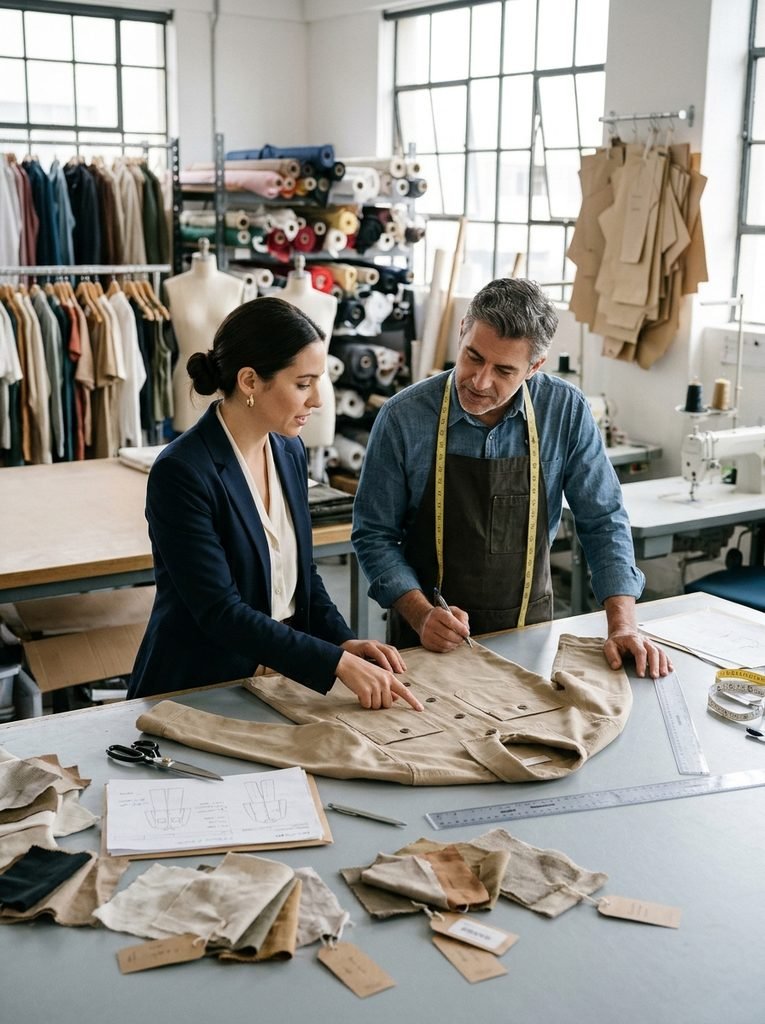
The minimum order quantity reshapes the launch
A manufacturer responds with a minimum order quantity of 120 pieces.
The founder initially assumes this allows 60 garments in each of two colours. The supplier clarifies that its minimum is 120 pieces per colour within the style.
The opening order therefore becomes 240 pieces.
That clarification also changes future design decisions. Adding another colour would require another 120 garments under the same terms.
MOQ is not always one number. Different parts of production can have separate minimums, and the largest constraint may determine what the buyer must commit to.
| Minimum condition | What it means | What the buyer should clarify |
|---|---|---|
| Per order | A minimum across the whole purchase | Whether different products can be combined |
| Per style | A minimum for each garment design | Whether small design changes create a separate style |
| Per colour | A minimum for each colour version | Whether available fabric colours have different terms |
| Per size | A required quantity in individual sizes | Whether the intended size distribution is accepted |
| Per material or component | A minimum for fabric, buttons, labels, or other inputs | Who pays for and owns unused quantities |
Harbour Thread also avoids dividing the order equally across sizes simply because that is convenient.
An equal split would produce 30 pieces of each size in each colour. That may be appropriate, but the founder has not yet established that demand will be evenly distributed.
The proposed allocation therefore becomes a specific discussion with the supplier rather than an assumption.
Another question concerns leftover materials. If the factory purchases more fabric than this batch uses, is that surplus included in the price? Does it belong to the manufacturer or the brand? Can it be stored for another order?
Those details can affect the cost and consistency of a reorder.
Lesson from this phase: Ask what the minimum applies to and how it affects every version of the product. An attractive headline MOQ can hide a much larger collection-level commitment.
The founder reduces complexity before increasing quantity
Harbour Thread’s original design includes specially finished buttons, a custom fabric colour, and printed presentation boxes.
The founder likes all three details. None has yet been tested with customers.
Rather than accepting a larger order to accommodate them, the founder requests a second version using available fabric colours, standard buttons, and simple protective packaging.
The design still has a distinctive fit. Its less visible purchasing requirements become easier to manage.
This is a practical way to approach low MOQ clothing manufacturers. Ask which product decisions make a smaller order feasible.
A supplier might be able to offer a lower minimum when using materials already in stock. Another might accept a small batch if the buyer pays a separate setup charge. A workshop specialising in short runs might structure its pricing differently from a production line organised around large repeat orders.
The relevant question is whether the arrangement works for the garment and the business.
Harbour Thread asks for the cost of both the simpler and more customised versions. The founder can then decide whether the additional details justify their additional commitment.
The business also separates essential features from preferences.
Fit and fabric feel remain priorities because they affect the customer’s experience. A bespoke box is postponed because it consumes money without improving the garment itself.
Lesson from this phase: Reducing unnecessary variation can make a small order more practical. Preserve the features that define the product and question the details that mainly increase complexity.
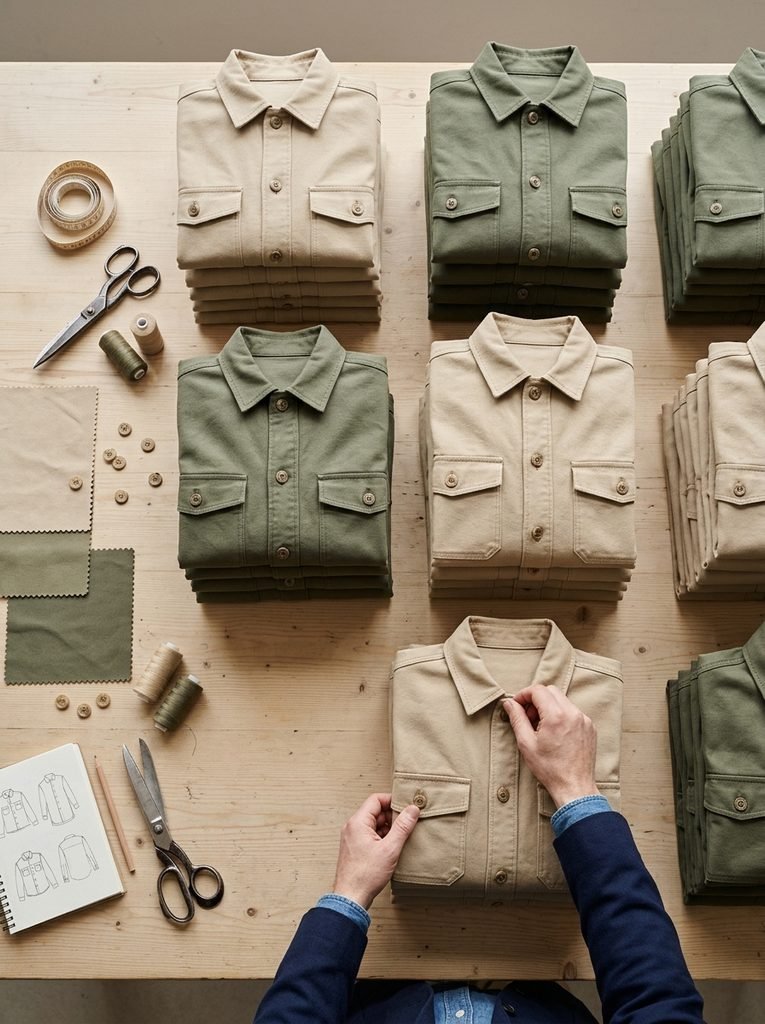
The clothing manufacturing cost becomes a complete budget
The preferred supplier quotes an illustrative production price of $16 per overshirt.
For 240 garments, the production invoice is:
240 × $16 = $3,840
That figure describes one part of the project. Harbour Thread still needs to account for development, checks, delivery, and other expenses associated with receiving usable stock.
The founder builds a planning budget.
| Budget item | Illustrative amount | Question to resolve |
|---|---|---|
| Production: 240 × $16 | $3,840 | Which materials and operations are included? |
| Pattern development and samples | $360 | How many revisions and sizes are covered? |
| Labels and packaging | $120 | Are these additional or already included? |
| Pre-shipment inspection | $180 | What will be checked and reported? |
| Transport and shipment cover | $300 | What journey and services are included? |
| Other delivery and handling allowance | $420 | Which actual charges must replace this allowance? |
| Payment and conversion costs | $60 | What will the chosen payment method cost? |
| Total planning budget | $5,280 | Before customer fulfilment and ongoing overhead |
All figures are hypothetical. The delivery allowance is not a tax estimate or a standard percentage.
The planned cost per ordered garment is:
$5,280 ÷ 240 = $22
The founder now has two useful numbers: a $16 production price and a $22 opening-order planning cost.
They answer different questions.
The production price helps compare equivalent manufacturing offers. The complete planning cost helps the business assess how much money this launch requires.
Development costs are kept visible because they may not recur in the same way. A repeat order using unchanged patterns could have a different cost structure, while a revised design could require further development.
The founder also checks for duplication. Labels should not appear as an additional charge if the production quote already includes them. Delivery services need clear boundaries so the same expense is not counted twice.
Lesson from this phase: Build the budget from its components. A single quoted price cannot show the full cost of developing and receiving an opening collection.
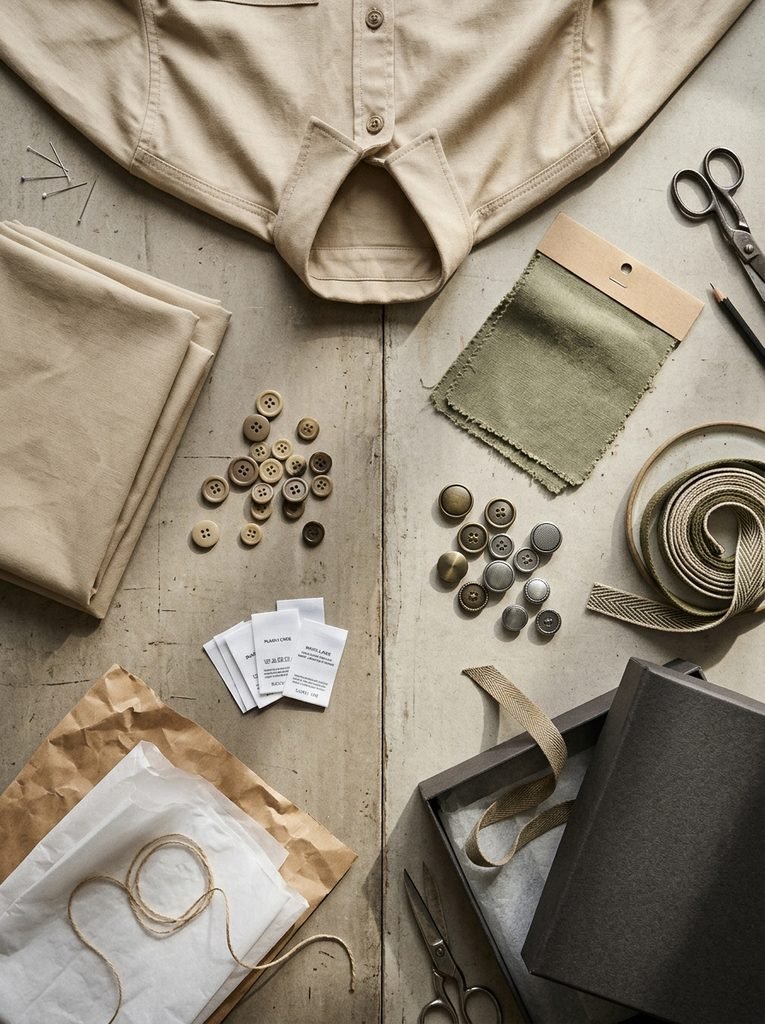
A lower price creates a higher purchasing commitment
Another manufacturer offers an illustrative price of $14.50 per garment, provided Harbour Thread orders 480 pieces.
The offer saves $1.50 on each garment at production level. It also doubles the number purchased.
| Comparison point | Opening-order option | Higher-volume option |
|---|---|---|
| Quantity | 240 garments | 480 garments |
| Production price per garment | $16.00 | $14.50 |
| Production invoice | $3,840 | $6,960 |
| Quantity above the opening plan | None | 240 garments |
| Main consideration | Higher production price per piece | Greater cash and inventory commitment |
The higher-volume option requires $3,120 more for production alone.
Harbour Thread has no evidence that it can sell the additional stock within a useful period. The founder therefore treats the discount as an offer to buy more, not as automatic savings for the business.
Unsold garments still occupy space. They also tie up money that might otherwise fund photography, customer service, product improvements, or a better-performing reorder.
The larger purchase could make sense later, once demand becomes clearer. At this stage, the smaller order gives the business more room to learn.
The founder also considers price sensitivity. If customers resist the intended retail price, the business may need to adjust its product or selling approach. Holding twice as much stock would make that adjustment harder.
Lesson from this phase: Compare the extra money committed with the evidence supporting extra demand. A lower unit price is valuable when the additional quantity has a credible purpose.
Supplier verification begins with clear responsibility
Before paying for samples, Harbour Thread checks who it is dealing with.
The founder requests the business’s legal name, operating address, registration details where available, and the identity of the organisation receiving payment.
The information is compared across the quotation, invoice, and proposed order documents.
A difference does not automatically prove wrongdoing. The seller may be a trading company working with an independent factory. However, the arrangement needs a clear explanation.
Harbour Thread separates three questions:
- Who is accepting the order?
- Where will the garments be produced?
- Who must address a problem with the finished order?
The founder then asks about relevant capability. General factory photographs are less useful than evidence of comparable work.
For this overshirt, the discussion covers woven fabrics, pocket construction, button attachment, pressing, and measurement checks. A workshop’s ability to produce another garment category does not fully demonstrate suitability for this one.
Where practical, Harbour Thread requests a live walkthrough or an independent visit. The purpose is to understand the production arrangement and ask specific questions.
A video call is only one piece of evidence. It does not settle every question about capacity, ownership, or responsibility.
References are approached in the same practical way. Instead of asking whether a supplier is “good,” the founder asks how closely bulk goods matched samples and how the business handled problems.
Lesson from this phase: Verify the organisation, understand the production arrangement, and identify responsibility. Clear answers are more useful than an impressive sales presentation.
Claims are matched to evidence
One supplier describes its garments as premium, sustainable, and carefully inspected.
Those words sound reassuring, but they leave Harbour Thread with questions.
What makes the product premium? Which material or process supports the sustainability claim? What does the inspection actually examine?
The founder asks for evidence relevant to each statement.
For a material claim, that might involve traceable documentation identifying what is being supplied. For a quality claim, it might involve an inspection procedure, measurement record, or sample assessment.
Any certification document is reviewed for its named business, applicable location, covered products or activities, and validity. Where possible, its authenticity is checked with the issuing organisation.
The founder avoids assuming that a document covering one component automatically supports a claim about the complete garment.
This discipline also improves customer communication. Harbour Thread should be able to explain its product in specific terms without relying on broad claims it cannot substantiate.
A precise description of fabric composition, construction, or intended fit is often more useful than an unsupported promise of exceptional quality.
The founder also keeps performance separate from documentation. Even a well-documented material must still suit the garment’s design and intended use.
Lesson from this phase: Ask what each claim means for the actual product. Evidence should support the precise statement the business intends to make.
Samples create an agreed production reference
Harbour Thread receives its first sample.
The colour and overall shape are promising, but the pocket openings are awkward and the cuffs feel too narrow. After washing, the garment also needs another measurement review.
These findings are recorded in a structured revision sheet.
The founder avoids instructions such as “make it more comfortable” without further explanation. Instead, the revision identifies which measurement or construction detail should change and why.
A useful sample review includes:
- Overall proportions and appearance.
- Measurements at defined points.
- Fit during ordinary movement.
- Access to pockets and fastenings.
- Seams and internal finishing.
- Fabric feel and appearance.
- Behaviour under the intended care process.
- Labels and packaging.
The founder confirms whether the sample uses the intended production materials. If it contains a substitute button or different fabric, that limitation is recorded rather than overlooked.
After revisions, Harbour Thread approves a reference sample alongside the updated specification.
The specification includes agreed tolerances, meaning the permitted variation around a measurement or requirement. These should be suitable for the garment and clear enough for both parties to apply consistently.
The factory also needs a matching reference. An approved sample kept only by the buyer is less helpful if production staff are working from older instructions.
Any later change is documented, including its effect on cost and timing.
Lesson from this phase: Sample approval should create a shared standard. A verbal agreement that the garment “looks good” leaves important production details unresolved.
Written terms connect the order to practical milestones
Once the sample is approved, Harbour Thread reviews the production documents.
They identify the garment, quantities, colours, sizes, specification version, packaging, and agreed price. They also explain when the production timetable begins.
That starting point matters.
A quoted production period may depend on final approval, material availability, or receipt of payment. Harbour Thread needs to know which conditions must be completed before work starts.
The founder builds a schedule that separates development, material preparation, production, inspection, dispatch, and arrival.
This gives the business a more useful basis for planning its launch than one broad delivery promise.
Payment terms receive similar attention. The founder considers what work or evidence supports each payment stage and how much money is exposed before the finished goods can be assessed.
There is no single payment structure that suits every order. The arrangement should be understood before funds are transferred.
The documents also explain how shortages, defects, substitutions, and delays will be handled. A promise to “sort it out” does not define a remedy.
A credit against another purchase may be acceptable, but it should not be mistaken for an immediate repayment. The founder considers whether the proposed solution would remain useful if the business chose not to reorder.
Pattern files, artwork, and unused materials are addressed explicitly as well.
Lesson from this phase: Write down the decisions that would otherwise become disagreements. Clear milestones and responsibilities make the order easier to manage.
Delivered quality changes the usable unit cost
Harbour Thread arranges a pre-shipment inspection against the agreed requirements.
The scope is defined in advance. Depending on the arrangement, the inspection may cover selected measurements, workmanship, packaging, and quantity checks.
An inspection of a sample of the shipment cannot establish that every garment is flawless. It provides evidence within the limits of the agreed process.
When the delivery arrives, the business counts and checks it promptly.
In this fictional example, eight garments are initially unsuitable for sale. Harbour Thread therefore has 232 immediately saleable pieces.
Using the earlier planning budget:
$5,280 ÷ 232 = approximately $22.76 per immediately saleable garment
The calculation assumes no repair, replacement, or reimbursement has yet occurred. It is a planning measure for this example, not a prescribed accounting method.
The difference between $22 and $22.76 shows why usable output matters.
Harbour Thread records each issue with photographs, quantities, and references to the agreed requirements. That makes the discussion with the supplier more concrete.
The founder also distinguishes manufacturing defects from unrelated selling problems. Slow demand is not a production fault. A customer preferring another fit is not automatically evidence that the garment was made incorrectly.
Lesson from this phase: Assess what the business can actually sell. Ordered quantity, received quantity, and immediately saleable quantity may be different.
The next order follows the evidence
After launch, Harbour Thread discovers that one colour sells steadily while the other moves more slowly. Demand is also uneven across sizes.
The next order should reflect those results.
Repeating the first size breakdown would be convenient, but it would ignore information the business has already paid to obtain.
The founder reviews product feedback, remaining stock, supplier communication, defect resolution, and the cash available for another purchase.
A reorder may increase the strongest colour while reducing the weaker one. It may preserve the same total quantity but improve the distribution.
Before approving it, Harbour Thread confirms the specification version and asks whether materials, production arrangements, or prices have changed.
The first successful delivery creates confidence. Continued consistency still needs attention.
A productive manufacturing relationship develops through clear expectations, consistent delivery, and workable responses to problems. The first order should test all three.
Frequently asked questions
Can I launch a clothing brand using existing products?
Yes. Ready-made garments or private-label options can reduce development work. The trade-off may be less control over fit, materials, and product availability. Ask exactly what can be customised and whether the same base garment will remain available for reorders.
What should my first message to a manufacturer include?
Include the garment type, basic design, material requirements, colours, size range, intended quantity, destination, and target timing. State whether you need pattern development or already have production files. A specific enquiry gives the supplier a better basis for discussing feasibility.
Should I choose a nearby factory or an overseas supplier?
Compare the actual businesses and complete purchasing arrangements. A nearby factory may make visits and revisions easier. An overseas supplier may offer a suitable combination of capability and cost. Distance alone does not establish quality, value, or reliability.
Is paying for samples reasonable?
Sample development requires work, so a separate charge can be reasonable. Clarify whether the fee includes patterns, materials, revisions, grading, and delivery. Also ask whether any amount is credited against production. Paying for a sample does not mean you must approve it.
Can I use a sourcing agent instead of contacting factories directly?
Yes, if the agent provides useful services such as supplier selection, communication, or production coordination. Understand the fees, factory relationships, and limits of responsibility. The arrangement should make it clear who accepts your order and who must resolve problems.