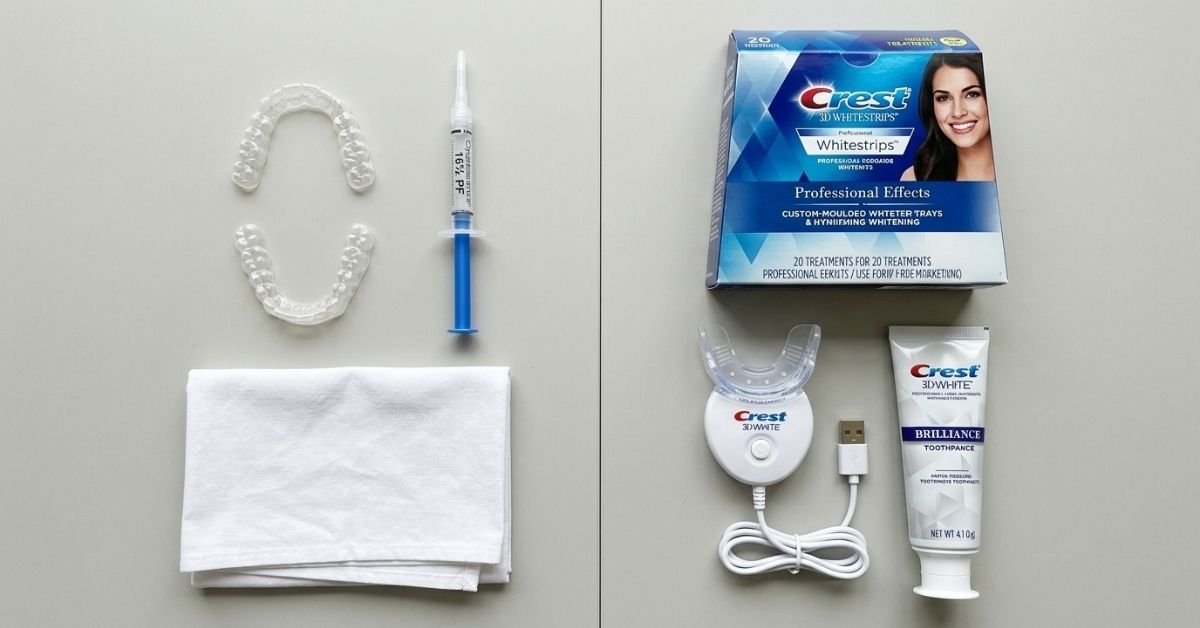
TEETH WHITENING PROFESSIONAL vs AT-HOME COST COMPARED
Almost everybody researching this topic makes the same error within the first five minutes. They set a supermarket whitening box beside a dental appointment quote, notice the enormous gap, and treat the decision as settled.
The problem is that those two numbers are not measuring the same thing. One is the price of beginning. The other is closer to the price of arriving. Confuse them and you can spend three years paying the cheap price repeatedly without ever reaching the result you wanted.
QUICK ANSWER: Clinic-based whitening usually costs the equivalent of USD 400–1,000 per session, dentist-fitted take-home trays around USD 200–600, and retail kits USD 20–150. Because retail products fade within months and must be rebought, three-year spending narrows the gap from roughly tenfold down to two- or threefold.
THE FULL PRICE PICTURE, ON ONE SCREEN
Dental pricing varies more between countries than almost any other consumer service, so treat the figures below as bands rather than quotes. They reflect private-pay pricing in higher-income markets; costs in many parts of Asia, Eastern Europe, Latin America and the Middle East commonly sit well below these ranges.
| Option | Typical price (USD equivalent) | Shades lifted | How long it lasts | Supervised |
|---|---|---|---|---|
| In-chair whitening session | 400–1,000+ | 4–8 | 1–3 years with upkeep | Yes |
| Dentist-fitted take-home trays | 200–600 | 3–6 | 1–2 years | Yes |
| Combined chair + tray package | 600–1,200 | 5–8 | 2–3 years | Yes |
| Internal bleaching (single dark tooth) | 300–600 | Varies | Several years | Yes |
| LED kit with generic mouthpiece | 30–150 | 1–3 | 4–8 months | No |
| Whitening strips | 20–60 | 1–3 | 4–6 months | No |
| Whitening pen | 15–30 | 0–1 | Weeks | No |
| Whitening toothpaste | 5–15 | Surface staining only | Ongoing | No |
REGIONAL BANDS FOR CLINIC WHITENING (APPROXIMATE)
| Region | In-chair session | Dentist trays |
|---|---|---|
| North America | USD 450–1,000 | USD 250–600 |
| Western Europe | EUR 350–800 | EUR 200–500 |
| United Kingdom | GBP 300–700 | GBP 200–450 |
| Australia & New Zealand | AUD 600–1,200 | AUD 350–700 |
| Gulf states | USD 350–900 | USD 200–550 |
| South & Southeast Asia | USD 80–300 | USD 60–200 |
| Eastern Europe | EUR 150–400 | EUR 100–300 |
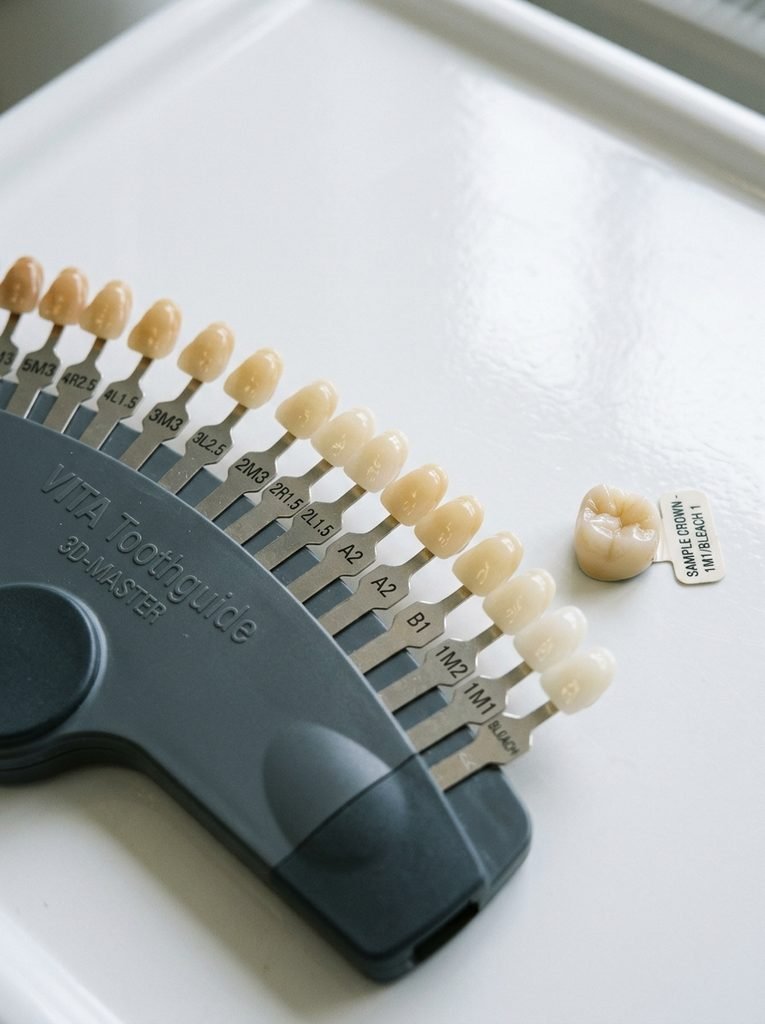
One principle applies identically everywhere, regardless of currency: whitening lightens natural tooth structure only. Ceramic crowns, veneers, bonded repairs and tooth-coloured fillings hold whatever shade they were made in. That single fact produces the largest hidden expense in this entire subject, and I will come back to it.
WHAT THE HIGHER PRICE ACTUALLY BUYS
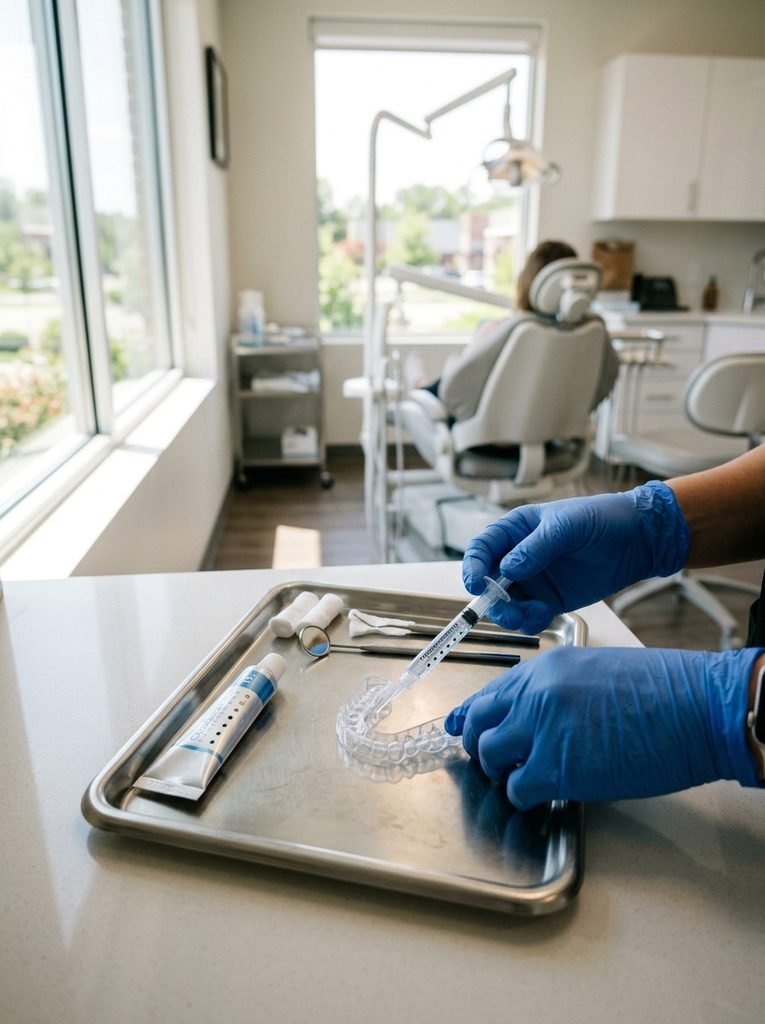
A clinic appointment is not simply a stronger version of what sits on a pharmacy shelf. You are paying for a peroxide concentration far above anything sold directly to consumers, protective barriers placed over the gum line, and a trained person watching your soft tissue while the chemistry works.
Viewed that way, the invoice makes more sense. The gel itself is a small share of the fee. Chair time, isolation, monitoring and the clinician’s judgement account for most of it.
Dentist-fitted trays occupy the middle ground for equally logical reasons. The fee covers a scan or impression of your arch, trays manufactured to fit your bite precisely, and prescription-strength gel. You then run the treatment yourself over roughly one to two weeks.
Retail products remove every one of those elements. Generic tray or strip, weaker gel, no examination, and nobody checking whether your particular discolouration will respond to bleaching in the first place.
COST PER SHADE: THE MATHS NOBODY PUBLISHES
Price alone tells you very little. Price divided by result tells you a great deal. Using mid-band figures and realistic shade movement:
| Option | Mid-band price (USD) | Typical shades gained | Cost per shade |
|---|---|---|---|
| In-chair session | 650 | 6 | ~108 |
| Dentist trays | 400 | 4.5 | ~89 |
| LED kit | 80 | 2 | ~40 |
| Strips (single pack) | 40 | 2 | ~20 |
By this measure the retail products win decisively, and that verdict is honest as far as it goes.
Their limitation is not efficiency but ceiling. Consumer formulas are legally capped in most countries, and a generic mouthpiece cannot hold gel against every tooth surface for long enough. Retail whitening reliably delivers its first two or three shades, then flattens. Buying five packs does not buy ten shades.
So the sensible reading is this. If your ambition is a fresher, cleaner-looking smile, the cheap route is genuinely efficient and there is no reason to overspend. If your ambition is a dramatic transformation, no quantity of retail product will get you there.

HOW LONG RESULTS SURVIVE AND WHAT UPKEEP ADDS
Longevity is the variable that quietly reverses the arithmetic.
A REALISTIC WHITENING TIMELINE
- Days 1–7 — Clinic result reaches its peak; a home-tray course is roughly halfway
- Weeks 2–3 — Teeth rehydrate and the shade settles slightly darker than day one
- Months 4–6 — Retail kit results have visibly faded
- Months 12–18 — Clinic results begin drifting back without maintenance
- Years 2–3 — Professional results are largely gone if never topped up
Diet dictates the pace more than the product does. Coffee, black tea, red wine, cola, tobacco, turmeric-heavy cooking, soy sauce and dark berries all pull colour back. A heavy daily coffee or tea habit can halve every interval above.
Maintenance economics differ sharply between the two routes. Once you own fitted trays, refill syringes cost roughly USD 20–50 and one syringe typically covers two or three refresh cycles. The expensive part was a one-time purchase.
Retail whitening has no equivalent. Every refresh means buying the entire product again, indefinitely.
THE THREE-YEAR TOTAL: WHERE THE GAP CLOSES
This is the comparison that ought to appear on every page about whitening and almost never does. Assume someone who wants to remain visibly whiter for three years rather than for one weekend.
| Route | Year 1 | Year 2 | Year 3 | Three-year total |
|---|---|---|---|---|
| Clinic session + trays for upkeep | 650 + 250 | 40 | 40 | ~980 |
| Dentist trays only | 400 | 50 | 50 | ~500 |
| Strips, replaced every 5 months | 96 | 96 | 96 | ~288 |
| LED kit plus refill gels | 140 | 60 | 60 | ~266 |
The tenfold headline gap becomes roughly twofold at the low end and under fourfold at the high end. That is a completely different decision from the one most people think they are making.
Dentist-fitted trays emerge as the quiet value option around half the cost of the full clinic route across three years, while delivering results retail kits structurally cannot match.
THE COSTS THAT NEVER APPEAR IN PRICE COMPARISONS
RESTORATIONS THAT STOP MATCHING. If you have crowns, veneers or composite bonding on visible teeth, whitening will lighten everything around them while they stay exactly as they are. Replacing a single crown to match a new shade commonly runs USD 800–2,500 depending on the market, and replacing bonding USD 100–400 per tooth. This one factor can invert the entire cost comparison, which is why a professional opinion before you buy anything is the cheapest step in this article.
SENSITIVITY MANAGEMENT. Desensitising pastes, fluoride gels or potassium-nitrate products add roughly USD 10–40. Clinic protocols usually build desensitiser into the fee. At home, you buy it separately, usually after discovering you need it.
THE FAILED ATTEMPT. Money spent on something that could never have worked is not money saved. Greyish discolouration from certain antibiotics taken in childhood, darkening after trauma to a single tooth, mottling from excess fluoride during development, and the natural yellowing of dentine with age all respond poorly or not at all to consumer bleaching. Repeat purchases do not change that.
POORLY FITTING TRAYS. Generic mouthpieces leak gel onto gum tissue. That is product wasted and tissue irritated, and it is the single most common reason a home kit underdelivers against its own packaging claims.
NON-DENTAL WHITENING SERVICES. Salon, kiosk and mobile whitening is typically priced between the two categories, roughly USD 80–300. Rules on who may legally apply peroxide gel differ enormously between countries and even between states or provinces, and supervision is not guaranteed. Check what your local regulations actually permit before booking.
SAFETY, SENSITIVITY AND THE PRICE OF GETTING IT WRONG
Peroxide whitening is a long-established procedure and, used as directed, does not dissolve or thin enamel. The usual side effects are temporary sensitivity to cold and short-lived gum irritation, and both typically settle within a few days of finishing.
Risk climbs with unsupervised repetition. The people who run into prolonged sensitivity are almost always those who ran course after course chasing a result their product was never capable of producing.
Improvised home remedies deserve a blunt warning. Charcoal powders, baking soda scrubbing, acidic fruit rubs and undiluted peroxide rinses do not bleach the deeper tooth structure. They abrade or erode the surface. Enamel does not regenerate, and the restorative dentistry needed afterwards costs many times more than any whitening option listed here.
Whitening is also the wrong move during untreated decay, active gum disease or with a cracked tooth. An examination that identifies those problems is inexpensive protection, wherever you live.
INSURANCE, PUBLIC HEALTH SCHEMES AND PAYMENT OPTIONS
Coverage is close to nonexistent worldwide. Whitening is classified as cosmetic in essentially every system, which places it outside both private dental insurance and publicly funded dental care.
Two partial exceptions come up occasionally. Internal bleaching of a tooth that darkened after root canal treatment is sometimes assessed as restorative rather than cosmetic. And whitening bundled into post-orthodontic care is sometimes discounted, though rarely covered.
What clinics do offer, almost everywhere, is payment structure — instalment arrangements, membership or savings plans carrying discounts on cosmetic work, and third-party financing. Scheduling whitening alongside a routine clean is the simplest saving available and usually requires nothing more than asking at the time of booking.
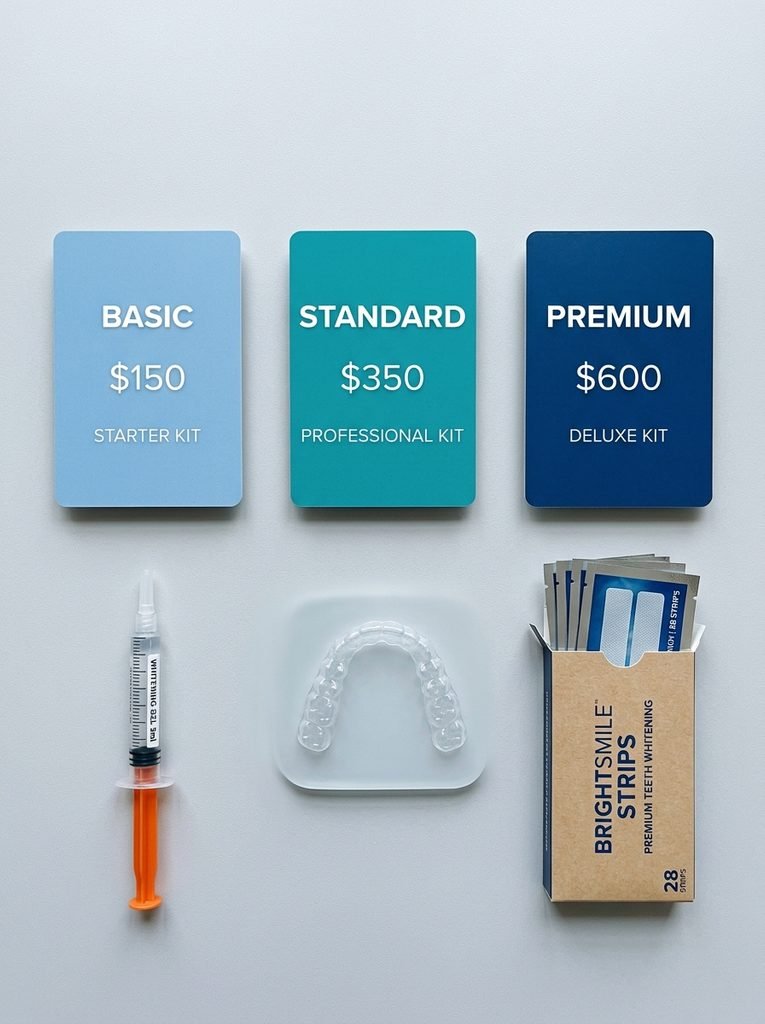
WHICH ROUTE SHOULD YOU CHOOSE
YOU NEED A LARGE CHANGE QUICKLY — In-chair whitening. Nothing else moves that many shades in a single visit, and at that gel strength the supervision is part of what you are paying for.
YOU WANT THE BEST LONG-TERM VALUE — Dentist-fitted trays. Slower across one to two weeks, results approaching clinic level, and every future top-up costs almost nothing once you own the trays.
YOUR STAINING IS MILD AND YOUR GOALS ARE MODEST — Strips or a tray kit. Two or three shades is a genuine, visible improvement, and paying clinic prices to achieve it is unnecessary.
YOU HAVE CROWNS, VENEERS OR BONDING IN VIEW — Get an opinion first, whatever your budget. In your situation the whitening is the inexpensive part of the decision.
YOUR DISCOLOURATION IS GREY, BANDED OR CONFINED TO ONE TOOTH — See a dentist. Retail products will not resolve this, and the money spent proving that is simply gone.
YOUR BUDGET IS TIGHT BUT YOU WANT LASTING RESULTS — Trays overtake repeat strip purchases within roughly eighteen months, and the advantage compounds every year afterwards.
KEY TAKEAWAYS
- Clinic whitening typically costs USD 400–1,000, dentist trays 200–600, retail kits 20–150, with wide regional variation
- Cost per shade favours retail products, but they plateau at two to three shades
- Across three years the totals converge to roughly 980, 500 and 260–290 respectively
- Dentist-fitted trays are the value sweet spot for most people in most markets
- Whitening cannot lighten crowns, veneers or fillings, and matching them afterwards can cost more than the whitening did
- Cosmetic classification means insurance and public schemes almost never contribute
- Abrasive home remedies cause permanent damage and lead to far higher repair bills
WHAT TO DO NEXT
- Check your front teeth in good light and count any crowns, veneers or visible fillings. That number alone determines whether you can shop freely or need advice first.
- Decide honestly how many shades you want to move. Two and six lead to completely different products.
- Ask two local clinics for an all-inclusive price covering any required examination or clean, and separately for the price of trays alone.
- Compare that figure against three years of your preferred retail kit not one pack.
- Book a professional clean before whitening by any method. Gel works on clean enamel and nothing else.
- Protect whatever result you get. A straw for cold dark drinks and a water rinse after coffee or tea buys months of additional life at no cost.
Every figure here is an approximate planning band drawn from general market patterns, not a quotation. The only price that genuinely applies to you is the written one your own dentist provide,
FAQ
IS PROFESSIONAL TEETH WHITENING WORTH THE HIGHER PRICE?
It is worth it when you want more than three shades of change, when you have restorations on visible teeth, or when retail products have already failed you. For light staining and modest goals, an at-home kit produces a visible result for a fraction of the outlay.
HOW MUCH DO DENTIST-FITTED WHITENING TRAYS COST?
Roughly USD 200–600 equivalent in higher-income markets and considerably less in many others. The fee covers the scan or impression, custom-made trays and an initial gel supply. Refill syringes afterwards typically cost USD 20–50.