
Menopause Skin Changes: Treatment Options And Cost
The most costly mistake in this whole subject is a quiet one: treating menopause skin changes as a moisturiser problem.
It is an understandable read of the situation. The skin turns dry and tight almost overnight, it stops tolerating products that were fine for two decades, and it looks flat in photographs it never used to. So the response is a heavier cream, then a more expensive heavier cream, then a facial. Months pass, several hundred dollars leave the account, and the skin is no different — because surface moisture was never the issue. The change is structural, happening several layers below anything a cream can reach.
Once you understand that, the entire spending order flips. And the flip usually saves money rather than costing it.
What Causes Menopause Skin Changes And How Are They Treated
Skin carries estrogen receptors, so it responds directly to hormonal decline. As estrogen falls, collagen is broken down faster than it is replaced, oil production drops and the skin barrier weakens — producing thinning, dryness, laxity and slower healing. Treatment combines barrier-repair skincare, sun protection, retinoids, hormone therapy where appropriate, and collagen-stimulating clinical procedures.
Menopause Skin Changes Are Simply Normal Aging Arriving On Schedule
Fact: They are a separate, hormone-driven acceleration sitting on top of ordinary aging — and the way they cluster gives it away.
Everyday chronological aging removes collagen slowly, at a pace low enough that no single year stands out. What happens around menopause is different in both speed and pattern. Estimates from dermatological research put the loss at roughly a third of skin collagen across the first five years after the final period, followed by a slower annual decline. That is the fastest structural change human skin ever goes through outside of injury.
The tell is that the changes arrive together rather than one at a time. Dryness, laxity, thinner skin over the hands, easier bruising, slower healing of small cuts, a duller surface — these share a single cause, which is why they show up in the same eighteen months.
The transition also begins earlier than most people expect. Estrogen does not glide downward; it swings, sometimes violently, for years before periods stop. That volatility is why skin behaves so erratically in the mid-to-late forties: congested one month, parched the next, suddenly reactive to a serum used for years.
A Richer Moisturiser Will Solve Menopausal Dryness
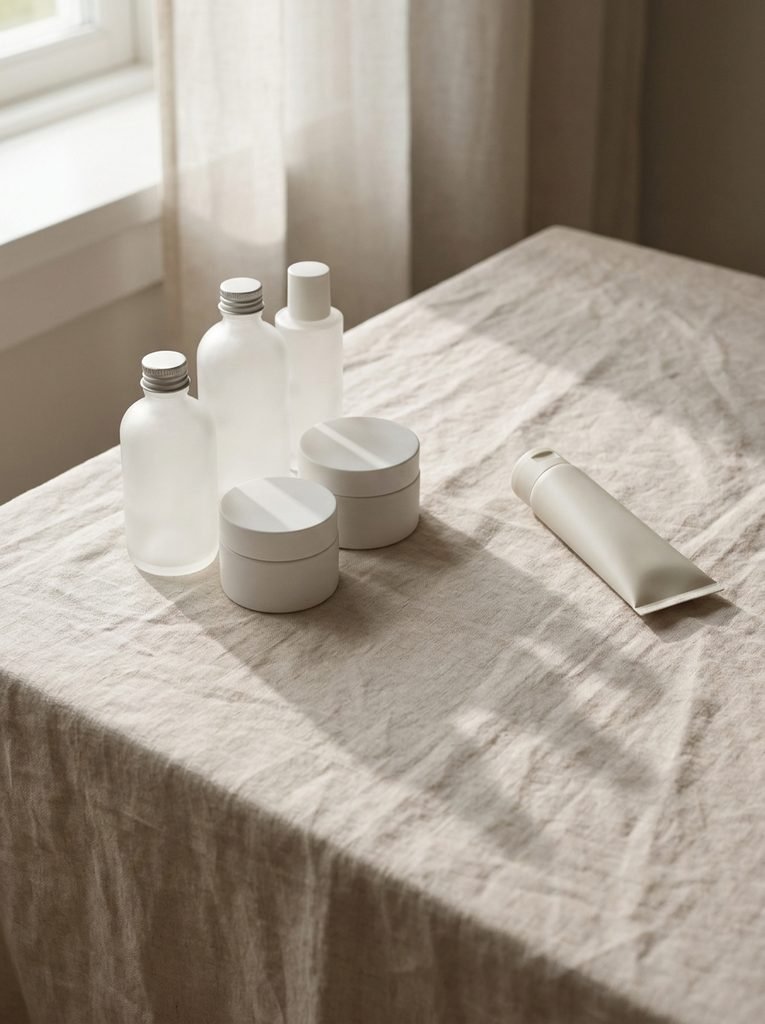
Fact: Moisturiser makes skin comfortable. It cannot restore a barrier that is producing less oil and holding less water in the first place.
Sebum output falls after menopause, and the skin’s own water-binding compounds decline with it. A dense cream slows evaporation and relieves the tight, itchy feeling — a real benefit that shouldn’t be dismissed — but it adds nothing to thickness, firmness or tone. That gap between how the skin feels and how it looks is exactly why the premium-cream route disappoints so many people.
What genuinely deserves a place in the routine:
- A barrier-repair moisturiser built around ceramides, glycerin, squalane or similar lipids, applied to damp skin twice daily.
- Daily broad-spectrum sun protection. Ultraviolet damage compounds hormonal thinning, and skipping it quietly cancels out everything else you pay for.
- A mild, non-stripping cleanser. Squeaky-clean was tolerable at thirty-five. At fifty-five it dismantles an already fragile barrier.
- A humectant serum layered underneath the moisturiser — never instead of it, since humectants without an occlusive above them can worsen dryness in low-humidity climates.
This layer is inexpensive everywhere in the world. Well-formulated pharmacy versions perform on par with luxury ones, because the useful ingredients are cheap, stable and long understood.
Collagen Supplements Rebuild What You Lost
Fact: Oral collagen shows modest measurable effects on hydration and elasticity, but it cannot direct new collagen to your face, and it does not counter estrogen decline.
Swallowed collagen is broken down into amino acids like any other dietary protein. Your body then rebuilds what it decides to build, where it decides to build it. Some trials in postmenopausal women do report small improvements in skin elasticity and moisture, and it would be dishonest to wave that away — but small is the operative word, and none of it substitutes for the interventions that work directly on skin.
A reasonable position: if you already have sun protection, a retinoid and adequate protein in your diet, a supplement is a defensible add-on. If you don’t, it is the wrong first purchase, and an expensive one in most currencies.

Hormone Therapy Is Prescribed To Improve Your Skin
Fact: Estrogen therapy does improve skin thickness, collagen content and hydration — but skin is never the reason it is prescribed, and any clinic marketing it that way deserves scepticism.
The dermatological effect is well documented and has been observed for decades. Women receiving estrogen therapy show greater skin collagen content and dermal thickness than those who aren’t, with changes measurable within months. The benefit appears strongest when treatment begins nearer the onset of menopause rather than a decade later.
The framing matters enormously, though. Hormone therapy exists to treat hot flushes, night sweats, disrupted sleep, mood changes, urogenital symptoms and bone loss problems with genuine health consequences. Improved skin is a welcome secondary effect, not an indication. If you already qualify on symptom grounds, your skin will probably benefit too. If you don’t, the risk-and-benefit conversation does not tip on appearance alone, and that discussion belongs with a clinician who knows your history.
How Cost Behaves Across Different Health Systems
| Access route | What it usually involves | Cost pattern worldwide |
|---|---|---|
| Publicly funded systems | Prescription through a family doctor or gynecologist | Free to a small fixed dispensing fee |
| Insurance-based systems | Covered when prescribed for menopausal symptoms | Modest copay; generics almost always cheapest tier |
| Fully private or self-pay | Consultation plus retail pharmacy price | Generic tablets and patches remain inexpensive; branded and compounded versions cost many times more |
| Telehealth subscriptions | Bundled consultation plus delivery | Convenient, consistently more expensive than a local generic prescription |
The pattern holds almost everywhere: generic estradiol and generic micronized progesterone sit among the cheapest medicines on the market, while branded delivery systems, custom-compounded blends and implanted pellets sit at the top and are rarely covered by anyone.
You Need Skincare Specifically Formulated For Menopause
Fact: “Menopause skincare” is a shelf category invented by marketing departments. The ingredients that change outcomes are the same ones dermatologists have recommended for forty years.
There is rarely anything in a menopause-branded product that isn’t available more cheaply under a plainer label. What actually moves the needle:
- Prescription retinoids (tretinoin and relatives) — the most thoroughly evidenced topical for photoaged skin, with documented effects on collagen production and epidermal thickness. A single tube typically lasts two to three months, and generic versions are inexpensive in most countries.
- Over-the-counter retinol or retinaldehyde — slower, gentler, and the sensible fallback where prescriptions are hard to obtain or the skin cannot tolerate the stronger option.
- Vitamin C or another antioxidant serum in the morning, for tone, pigmentation and environmental protection.
- Azelaic acid — quietly one of the most useful actives in this age group, because it addresses redness and adult breakouts simultaneously without stripping.
- Topical estrogen preparations for facial skin — used in some practices to improve dermal thickness. Worth raising with a clinician rather than sourcing independently.
One cost note that applies internationally: many insurers and public systems classify retinoids as cosmetic when prescribed for aging rather than acne, which can mean no subsidy at all. Where that happens, the generic cash price is usually still low enough not to matter.
Menopausal Breakouts Should Be Treated Like Teenage Acne
Fact: Applying teenage acne logic to menopausal skin makes both problems worse, because the skin underneath is thin and dry rather than oily.
Breakouts in this phase concentrate along the jawline, chin and neck, and they appear on skin that is dehydrated at the same time. Harsh cleansers, strong peroxide washes and alcohol-based toners attack the spots and demolish the barrier in the same pass, producing skin that is simultaneously broken out and raw — a combination that then gets misread as needing even more treatment.
Better-matched options include topical retinoids, which handle the breakouts and the aging together, azelaic acid, and for suitable patients an oral anti-androgen medication commonly used for hormonal acne. That last one is a prescription conversation, not a self-directed experiment.
Only Clinic Procedures Produce Real Results
Fact: They do produce the most visible structural change. They also cost the most, are almost never subsidised for cosmetic use, and perform poorly for people who skipped every rung below them.
Energy-based and injectable treatments work by creating controlled, deliberate injury or by placing a stimulus in the dermis, prompting the body to lay down new collagen. The biology is sound. The economics are where readers get hurt, because pricing for identical procedures diverges wildly across markets.
Rather than quote one country’s price list, here is how the treatments rank against each other — a ratio that stays broadly stable worldwide even when the currency changes.
| Treatment | What it addresses | Relative cost per session | Sessions typically needed |
|---|---|---|---|
| Light chemical peel | Tone, dullness, superficial texture | 1x (baseline) | 3–6 |
| Standard microneedling | Texture, fine lines, mild laxity | 1–2x | 3–6 |
| Light-based tone treatment | Pigmentation, redness, sun damage | 2–3x | 3–5 |
| Radiofrequency microneedling | Tightening plus texture | 4–6x | 3–4 |
| Non-ablative fractional laser | Fine lines, pigment, overall quality | 6–10x | 2–5 |
| Ablative fractional resurfacing | Deeper lines, significant texture change | 10–20x | 1–3 |
| Botulinum toxin | Expression lines only | 2–4x | Every 3–4 months |
| Collagen-stimulating injectable | Volume loss and dermal thickness | 5–8x per vial | 2–3 vials |
| Ultrasound or radiofrequency tightening | Mild to moderate laxity | 8–15x | 1–2 |
Three cost tiers to orient yourself:
- High-cost markets — North America, Western Europe, Australia, New Zealand, Japan, Singapore, the Gulf states. Expect a light peel in the low hundreds of US dollars and full ablative resurfacing in the low thousands.
- Mid-tier markets — Central and Eastern Europe, Latin America, Turkey, Malaysia, Thailand, South Africa. Typically 40% to 70% of high-tier pricing for equivalent technology and training.
- Lower-cost markets — South Asia, much of Southeast Asia, parts of Africa and the Middle East. Often 15% to 40% of high-tier pricing, with the widest quality spread between practitioners.
That last point deserves emphasis. Price differences between countries are mostly real and driven by local economics. Price differences within a city usually reflect who is holding the device, how deep they are treating, and whether numbing, aftercare and follow-ups are inside the quote or billed separately. Ask that question before comparing two numbers.
And the honest caveat: resurfacing performed on skin that receives no sun protection and no retinoid afterwards buys a result that fades. The cheap maintenance layer is what protects the expensive investment.
Once The Early Window Passes, Nothing Will Help
Fact: The window decides how much you preserve versus how much you must rebuild. It does not decide whether treatment works at all.
Retinoids improve photoaged skin at any age. Collagen stimulation works at any age. Sun protection prevents further damage at any age. What shifts is the effort-to-result ratio. At fifty, most of the work is protective — inexpensive, undramatic and highly effective. At seventy, more of it is reconstructive — slower, costlier and more dependent on procedures.
The takeaway isn’t resignation. It’s sequencing: build the low-cost layer regardless of where you are in the timeline, then decide with clear eyes whether procedures are worth it to you personally.
Menopause Skin Changes: Myth Versus Fact At A Glance
| Myth | Fact |
|---|---|
| It is ordinary aging | Hormonally accelerated; follows estrogen loss, not birthdays |
| A richer cream fixes it | Relieves discomfort only; no effect on structure |
| Supplements rebuild facial collagen | Small hydration and elasticity effect; not a structural repair |
| Hormone therapy is a skin treatment | Prescribed for symptoms and health; skin benefit is secondary |
| Menopause-branded products are necessary | Same actives, higher price, better packaging |
| Treat breakouts like teenage acne | Stripping thin, dry skin makes both problems worse |
| Only procedures work | They do the most, cost the most, and fail without maintenance |
| It is too late after the early years | Later means rebuilding rather than preserving, not futility |
What To Do Next
- Build the base layer this week. Gentle cleanser, barrier-repair moisturiser, daily broad-spectrum sunscreen. This is the cheapest step and the one with the highest return anywhere in the world.
- Add a retinoid. Prescription strength if you can access it, over-the-counter retinol if you cannot. Start twice a week and build tolerance slowly over two months.
- Book one proper clinical conversation about your whole symptom picture rather than your face alone. That is where hormone therapy either belongs or doesn’t, and a doctor who knows your history is the only person who can make that call.
- Wait six months before spending on procedures. Most people badly underestimate what a retinoid plus consistent sun protection will do, and you will make a far better-informed decision afterwards.
- Collect three quotes for any procedure, and ask each clinic exactly what is included. The variation between quotes for identical treatment is the single largest controllable cost in this article.
- Protect whatever you spend. Sun protection is what determines how long any result lasts, no matter which rung of the ladder you stopped at.
FAQ
When do menopause skin changes usually start?
Often during perimenopause, years before periods stop, because estrogen fluctuates before it settles low. Dryness and new sensitivity typically appear first, followed by loss of firmness. The most rapid structural change occurs in the few years after the final period.
Can hormone therapy reverse wrinkles?
It improves skin thickness, collagen content and hydration, and those effects are measurable — but it is not a wrinkle treatment and is not prescribed as one. The skin benefit tends to be strongest when therapy begins closer to the onset of menopause.
Is any of this covered by public health systems or insurance?
Hormone therapy usually is, particularly generic versions. Medical dermatology consultations often are. Retinoids prescribed for aging rather than acne are frequently classified as cosmetic and excluded. Purely cosmetic procedures are almost never covered anywhere.
What is the cheapest routine that actually works?
A gentle cleanser, a barrier-repair moisturiser, daily sun protection and a retinoid. That combination outperforms most premium routines assembled without a retinoid, and it costs a fraction as much in every market.
Why has my skin suddenly become sensitive to products I used for years?
The barrier is thinner and producing less oil, so actives penetrate more aggressively and irritate more easily. Reducing frequency, applying actives over a layer of moisturiser and dropping physical scrubs usually settles it within a few weeks.